PRODUCT STRATEGY
HRTECH
AI PRODUCT DESIGN
UX RESEARCH
PRODUCT STRATEGY
HRTECH
Demystifyd
Role
Product Designer
Product
Designer
Scope
AI Job Finder, Onboarding, University Systems
Tools
Figma, Figma Make, Claude, Google Stitch
Figma, FigmaMake, Claude, Google Stitch

Live Product:
www.demystifyd.com
IMPACT
↓ 50%
Onboarding drop-off reduced
↑ 25%
Feature adoption increased
↑ 18%
Premium conversion improved
↑ Faster
Understanding of platform value
IMPACT
↓ 50%
Onboarding drop-off reduced
↑ 25%
Feature adoption increased
↑ 18%
Premium conversion improved
↑ Faster
Feature adoption
About Demystifyd
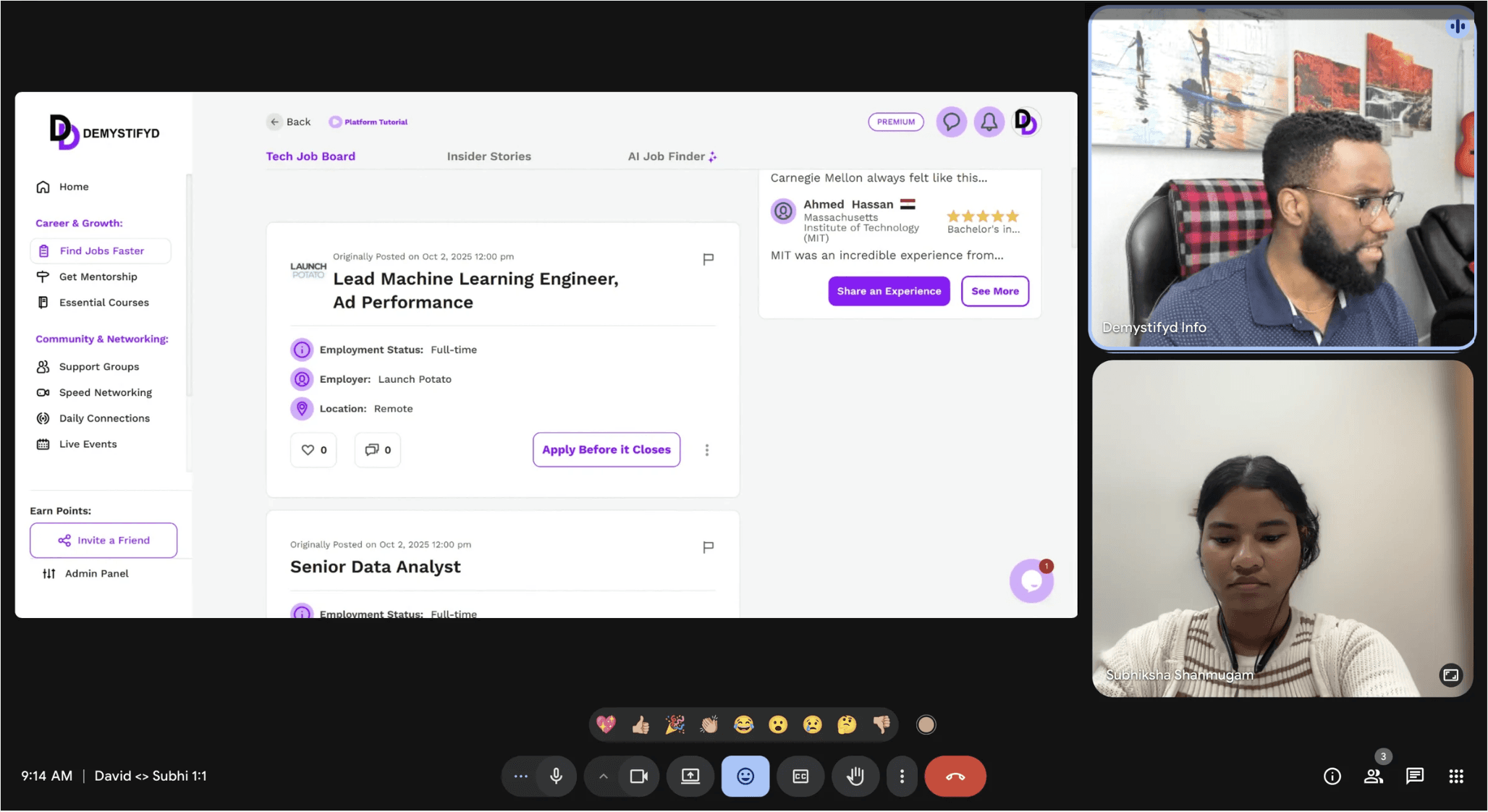
Demystifyd is an AI-powered career platform helping international students navigate visa-sponsored job discovery, networking, and career growth in the U.S.
This case study focuses on redesigning onboarding and AI Job Finder to help users reach value faster while improving activation and premium conversion.
Problem
Users struggled to discover relevant visa-sponsoring opportunities and often dropped off during onboarding before reaching the platform’s core value.
At the same time, the business aimed to improve feature adoption and premium conversion.
Solution
I redesigned the onboarding and AI Job Finder experience to create a more personalized, action-driven flow that reduced friction, improved job discovery, and supported scalable university experiences.
Research Method
To understand why users struggled to reach value, I conducted mixed-method UX research combining behavioral analysis, stakeholder discussions, and usability testing.
User Interviews & Behavioral Analysis
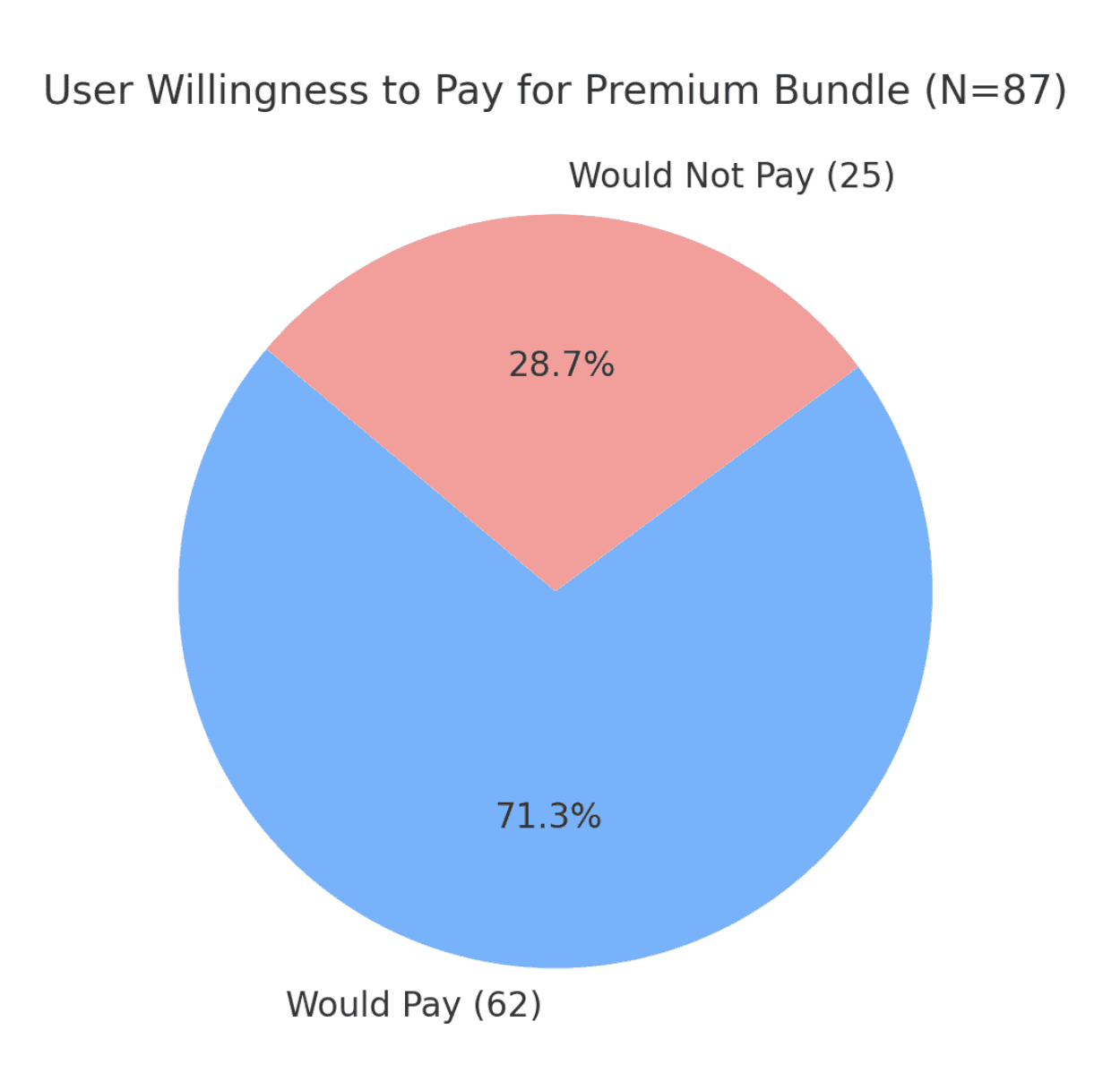
Conducted 90+ interviews and reviewed onboarding behavior to understand user goals, frustrations, willingness to pay, and drop-off patterns.
Stakeholder Interviews
Worked closely with stakeholders to align user needs with premium conversion, feature adoption, and university scalability goals.

Usability Testing
Observed users completing onboarding and job discovery tasks to identify confusion, cognitive overload, and friction points.
KEY INSIGHTS &
User comments
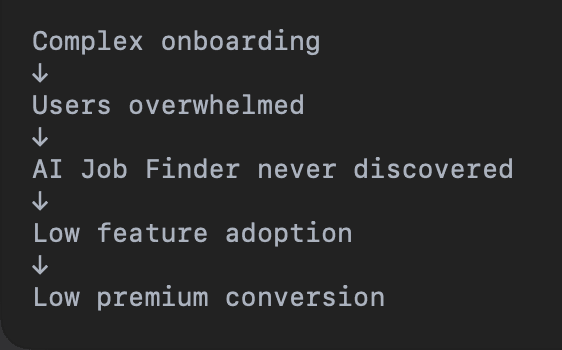
Long onboarding flows created cognitive overload
USER - "The tutorial felt overwhelming and difficult to follow. It became harder to understand the platform and its features.”
The most requested features were the H-1B Job Board and AI Job Finder, indicates users valued faster access to visa-sponsoring opportunities
USER - "It can be overwhelming and time-consuming to sift through multiple job boards manually, so having a tool that streamlines and personalizes that process would be incredibly valuable."
Personalized recommendations were seen as more valuable when considering paying for premium.
KEY INSIGHTS &
User comments
Long onboarding flows created cognitive overload
USER - "The tutorial felt overwhelming and difficult to follow. It became harder to understand the platform and its features.”
The most requested features were the H-1B Job Board and AI Job Finder, indicates users valued faster access to visa-sponsoring opportunities
USER - "It can be overwhelming and time-consuming to sift through multiple job boards manually, so having a tool that streamlines and personalizes that process would be incredibly valuable."
Personalized recommendations were seen as more valuable when considering paying for premium.
WHY USERS FAILED BEFORE REACHING VALUE
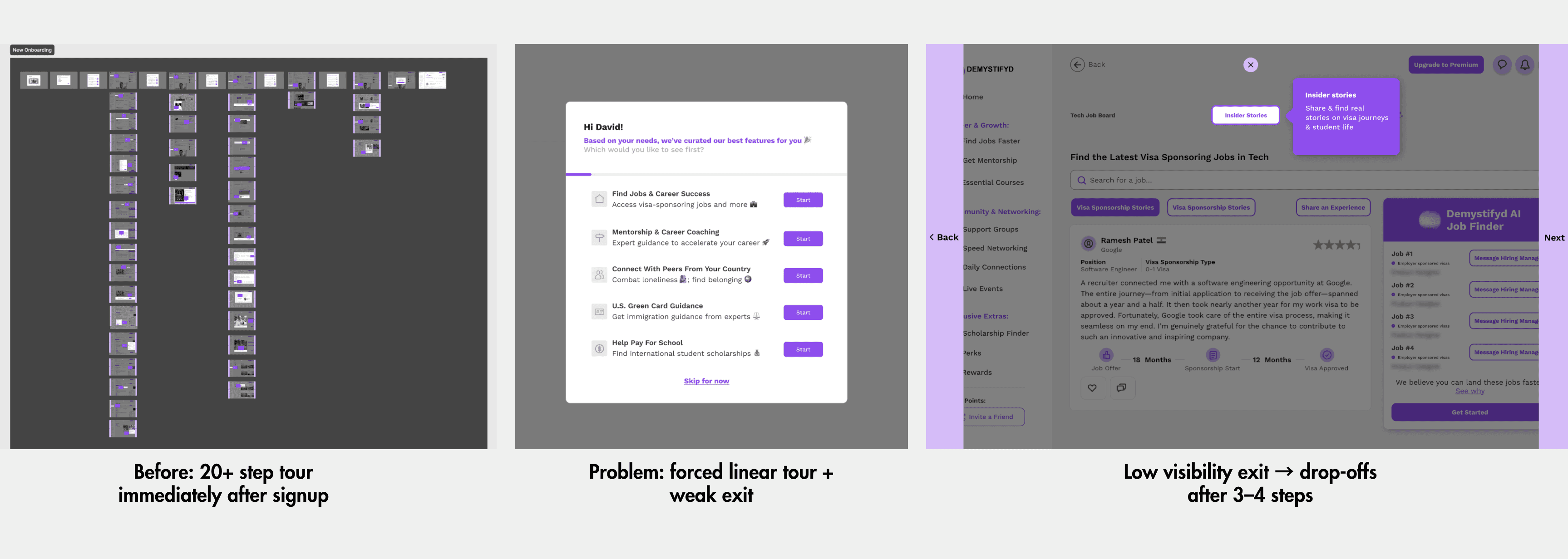
01 — Feature-heavy onboarding created early drop-off
The onboarding flow launched users into a long mandatory walkthrough that attempted to explain every feature upfront. This created cognitive overload, low discoverability of key actions, and early drop-offs before users reached the platform’s core value.
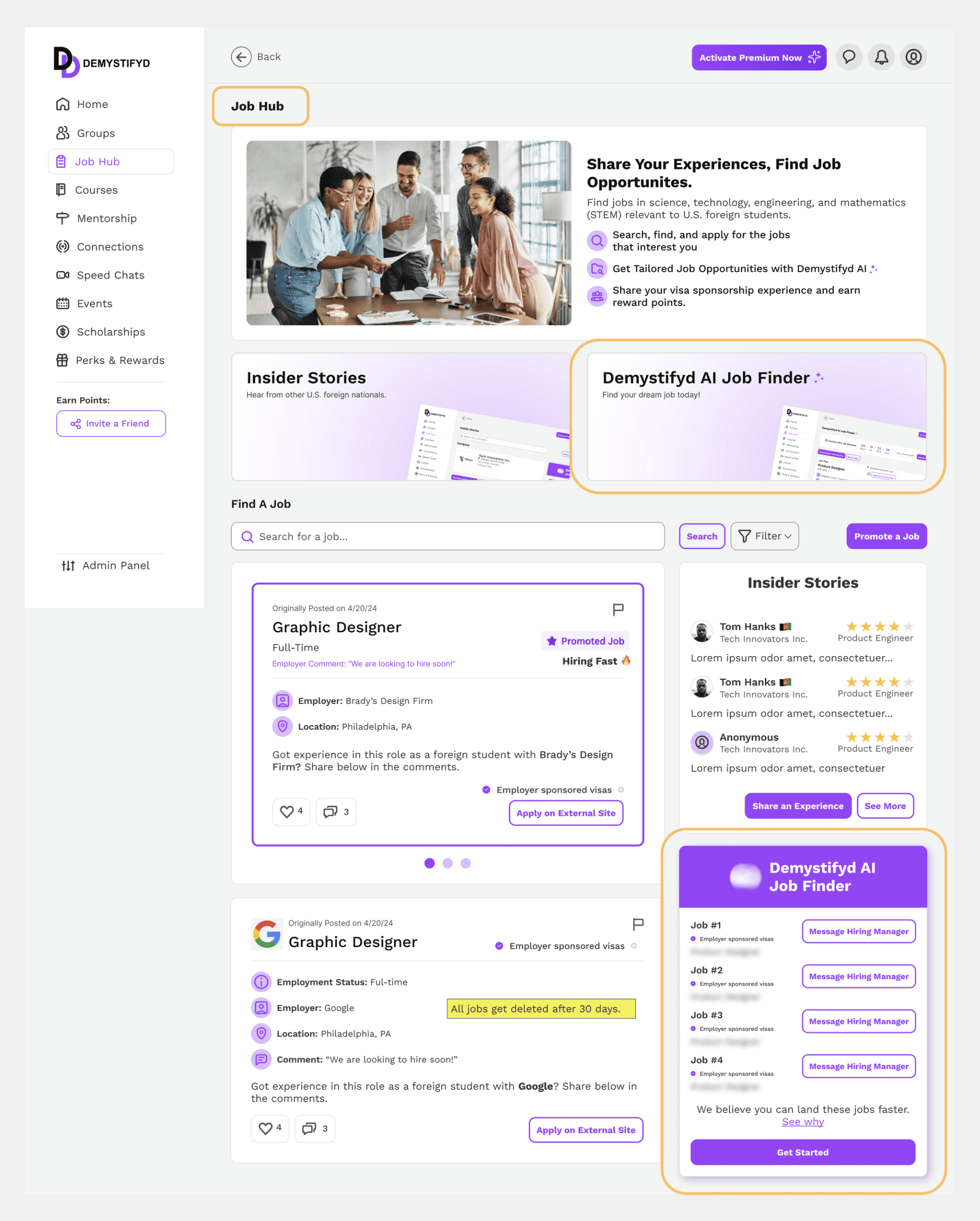
02 — AI Job Finder was visually competing with the job board
AI Job Finder visually competed with the job board, making it unclear where users should start. As a result, many defaulted to manual job search instead of engaging with AI-powered discovery.
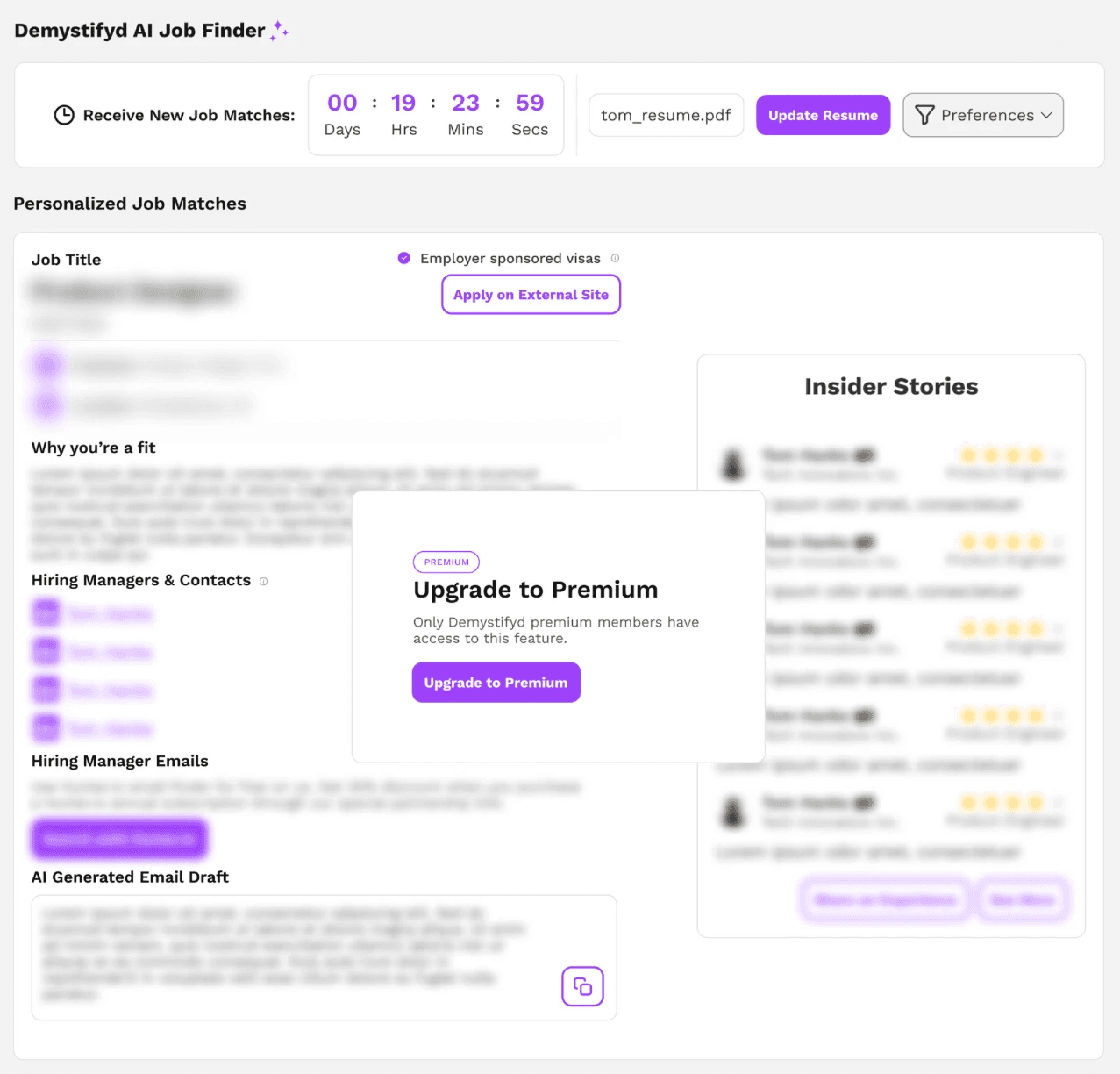
03 — Paywall-first experience limited value visibility
Restricting AI Job Finder behind Premium prevented users from experiencing its benefits early.
DESIGN STRATEGY
To reduce onboarding friction and improve job discovery, I focused on three core strategy shifts:
01 — Shift from explanation-first → personalized onboarding
Help users reach value faster through goal-based onboarding, guided interactions, and lightweight walkthroughs.
02 — Make AI Job Finder the primary discovery experience
Prioritize AI-powered job discovery over manual exploration while still allowing seamless access to the job board.
03 — Shift from paywall-first → value-first monetization
Allow users to experience AI Job Finder before requiring Premium access to improve feature adoption and conversion.
IMPACT
↓ 50%
Onboarding drop-off reduced
↑ 25%
Feature adoption increased
↑ 18%
Premium conversion improved
↑ Faster
Feature adoption
IMPACT
↓ 50%
Onboarding drop-off reduced
↑ 25%
Feature adoption increased
↑ 18%
Premium conversion improved
↑ Faster
Understanding of platform value
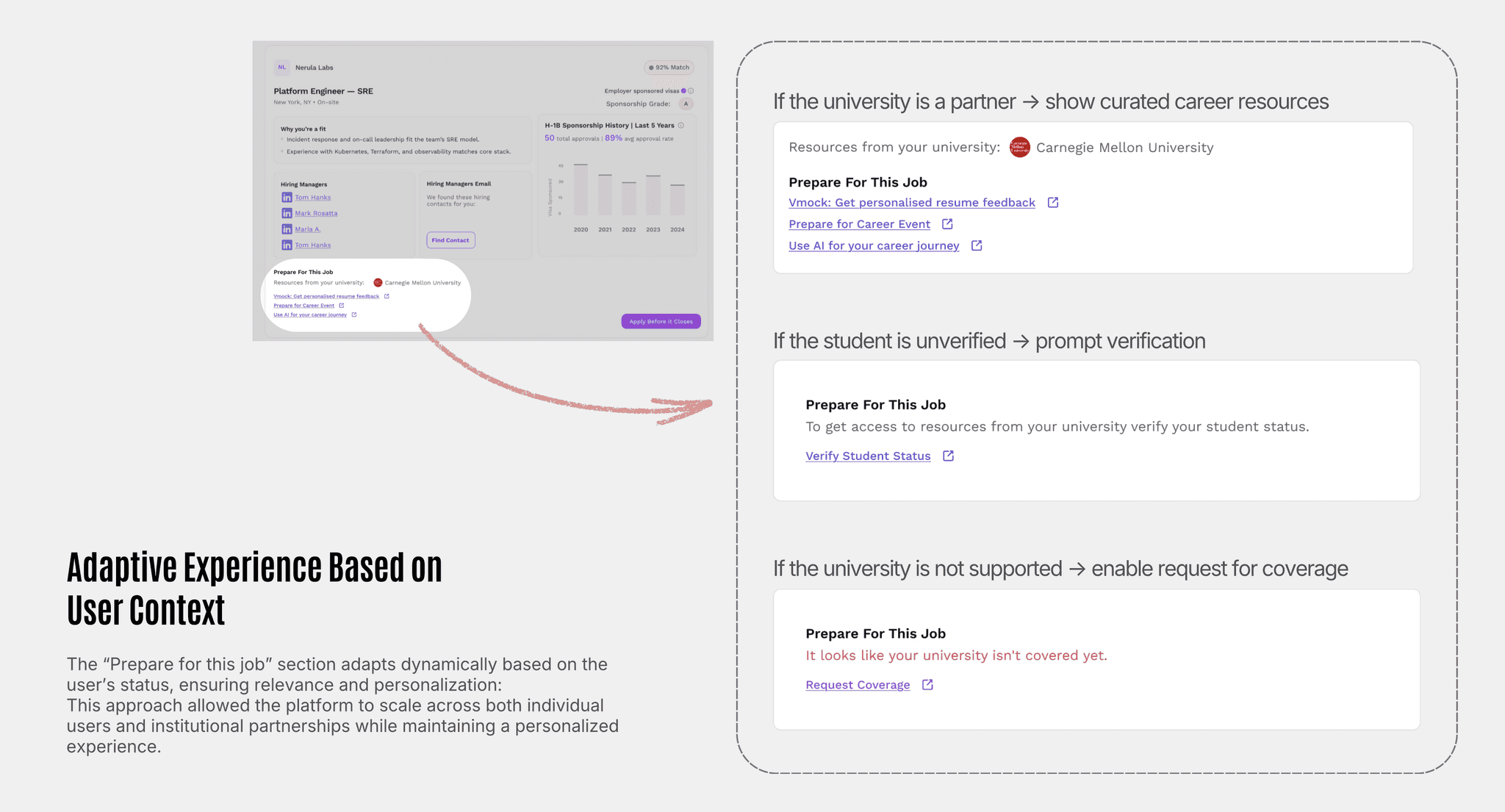
Designing for Different User Contexts
As the platform expanded toward university partnerships, the experience needed to adapt dynamically based on verification status, institutional access, and user eligibility.
SCALING THROUGH INTERNAL SYSTEMS (B2B)
To support university partnerships and adaptive experiences at scale, I also designed internal tools for managing university resources, student verification, and partnership-based access.
These systems helped operationalize experiences while giving the team flexibility to manage institutional partnerships and resource distribution efficiently.
Constraints & Tradeoffs
AI Infrastructure Cost
Personalized AI outputs increased token cost
Unlimited usage was not scalable
Decision:
Introduced limited free AI matches with value-first monetization.
Product Direction Shift
Product expanded from students → university partnerships
Required scalable institutional experiences
Decision:
Introduced adaptive university-based experiences and curated career resources.
CROSS-FUNCTIONAL COLLABORATION
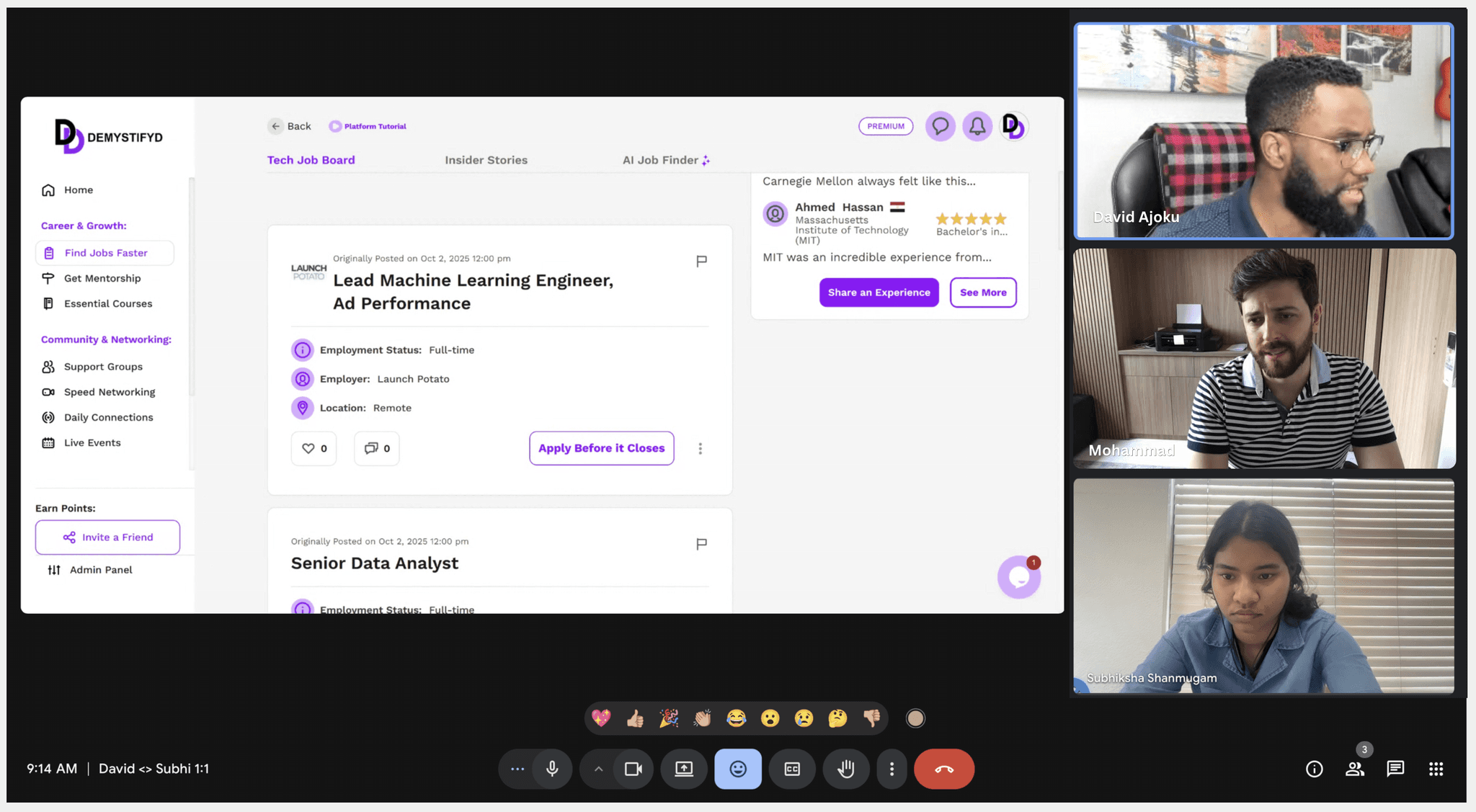
Worked closely with developers and stakeholders throughout implementation, creating structured Figma systems, annotated flows, interaction documentation, and edge-case guidance to support smoother handoff and scalability.
REFLECTION
This project strengthened my product thinking by teaching me how onboarding, personalization, monetization, and feature discovery all influence activation and retention. Looking back, I would introduce more contextual nudges and in-product guidance instead of relying on walkthroughs, helping users learn features naturally while interacting with the platform.

Hi
Let’s build something impactful together
PRODUCT STRATEGY
HRTECH
AI PRODUCT DESIGN
UX RESEARCH
PRODUCT STRATEGY
HRTECH
Demystifyd
Role
Product Designer
Product
Designer
Scope
AI Job Finder, Onboarding, University Systems
Tools
Figma, Figma Make, Claude, Google Stitch
Figma, FigmaMake, Claude, Google Stitch
Live Product:
www.demystifyd.com
IMPACT
↓ 50%
Onboarding drop-off reduced
↑ 25%
Feature adoption increased
↑ 18%
Premium conversion improved
↑ Faster
Understanding of platform value
IMPACT
↓ 50%
Onboarding drop-off reduced
↑ 25%
Feature adoption increased
↑ 18%
Premium conversion improved
↑ Faster
Feature adoption
About Demystifyd
Demystifyd is an AI-powered career platform helping international students navigate visa-sponsored job discovery, networking, and career growth in the U.S.
This case study focuses on redesigning onboarding and AI Job Finder to help users reach value faster while improving activation and premium conversion.
Problem
Users struggled to discover relevant visa-sponsoring opportunities and often dropped off during onboarding before reaching the platform’s core value.
At the same time, the business aimed to improve feature adoption and premium conversion.
Solution
I redesigned the onboarding and AI Job Finder experience to create a more personalized, action-driven flow that reduced friction, improved job discovery, and supported scalable university experiences.
Research Method
To understand why users struggled to reach value, I conducted mixed-method UX research combining behavioral analysis, stakeholder discussions, and usability testing.
User Interviews & Behavioral Analysis
Conducted 90+ interviews and reviewed onboarding behavior to understand user goals, frustrations, willingness to pay, and drop-off patterns.
Stakeholder Interviews
Worked closely with stakeholders to align user needs with premium conversion, feature adoption, and university scalability goals.
Usability Testing
Observed users completing onboarding and job discovery tasks to identify confusion, cognitive overload, and friction points.
KEY INSIGHTS &
User comments
Long onboarding flows created cognitive overload
USER - "The tutorial felt overwhelming and difficult to follow. It became harder to understand the platform and its features.”
The most requested features were the H-1B Job Board and AI Job Finder, indicates users valued faster access to visa-sponsoring opportunities
USER - "It can be overwhelming and time-consuming to sift through multiple job boards manually, so having a tool that streamlines and personalizes that process would be incredibly valuable."
Personalized recommendations were seen as more valuable when considering paying for premium.
KEY INSIGHTS &
User comments
Long onboarding flows created cognitive overload
USER - "The tutorial felt overwhelming and difficult to follow. It became harder to understand the platform and its features.”
The most requested features were the H-1B Job Board and AI Job Finder, indicates users valued faster access to visa-sponsoring opportunities
USER - "It can be overwhelming and time-consuming to sift through multiple job boards manually, so having a tool that streamlines and personalizes that process would be incredibly valuable."
Personalized recommendations were seen as more valuable when considering paying for premium.
WHY USERS FAILED BEFORE REACHING VALUE
01 — Feature-heavy onboarding created early drop-off
The onboarding flow launched users into a long mandatory walkthrough that attempted to explain every feature upfront. This created cognitive overload, low discoverability of key actions, and early drop-offs before users reached the platform’s core value.
02 — AI Job Finder was visually competing with the job board
AI Job Finder visually competed with the job board, making it unclear where users should start. As a result, many defaulted to manual job search instead of engaging with AI-powered discovery.
03 — Paywall-first experience limited value visibility
Restricting AI Job Finder behind Premium prevented users from experiencing its benefits early.
DESIGN STRATEGY
To reduce onboarding friction and improve job discovery, I focused on three core strategy shifts:
01 — Shift from explanation-first → personalized onboarding
Help users reach value faster through goal-based onboarding, guided interactions, and lightweight walkthroughs.
02 — Make AI Job Finder the primary discovery experience
Prioritize AI-powered job discovery over manual exploration while still allowing seamless access to the job board.
03 — Shift from paywall-first → value-first monetization
Allow users to experience AI Job Finder before requiring Premium access to improve feature adoption and conversion.
IMPACT
↓ 50%
Onboarding drop-off reduced
↑ 25%
Feature adoption increased
↑ 18%
Premium conversion improved
↑ Faster
Feature adoption
IMPACT
↓ 50%
Onboarding drop-off reduced
↑ 25%
Feature adoption increased
↑ 18%
Premium conversion improved
↑ Faster
Understanding of platform value
Designing for Different User Contexts
As the platform expanded toward university partnerships, the experience needed to adapt dynamically based on verification status, institutional access, and user eligibility.
SCALING THROUGH INTERNAL SYSTEMS (B2B)
To support university partnerships and adaptive experiences at scale, I also designed internal tools for managing university resources, student verification, and partnership-based access.
These systems helped operationalize experiences while giving the team flexibility to manage institutional partnerships and resource distribution efficiently.
Constraints & Tradeoffs
AI Infrastructure Cost
Personalized AI outputs increased token cost
Unlimited usage was not scalable
Decision:
Introduced limited free AI matches with value-first monetization.
Product Direction Shift
Product expanded from students → university partnerships
Required scalable institutional experiences
Decision:
Introduced adaptive university-based experiences and curated career resources.
CROSS-FUNCTIONAL COLLABORATION
Worked closely with developers and stakeholders throughout implementation, creating structured Figma systems, annotated flows, interaction documentation, and edge-case guidance to support smoother handoff and scalability.
REFLECTION
This project strengthened my product thinking by teaching me how onboarding, personalization, monetization, and feature discovery all influence activation and retention. Looking back, I would introduce more contextual nudges and in-product guidance instead of relying on walkthroughs, helping users learn features naturally while interacting with the platform.
Hi
Let’s build something impactful together
PRODUCT STRATEGY
HRTECH
AI PRODUCT DESIGN
UX RESEARCH
PRODUCT STRATEGY
HRTECH
Demystifyd
Role
Product Designer
Product
Designer
Scope
AI Job Finder, Onboarding, University Systems
Tools
Figma, Figma Make, Claude, Google Stitch
Figma, FigmaMake, Claude, Google Stitch
Live Product:
www.demystifyd.com
IMPACT
↓ 50%
Onboarding drop-off reduced
↑ 25%
Feature adoption increased
↑ 18%
Premium conversion improved
↑ Faster
Understanding of platform value
IMPACT
↓ 50%
Onboarding drop-off reduced
↑ 25%
Feature adoption increased
↑ 18%
Premium conversion improved
↑ Faster
Feature adoption
About Demystifyd
Demystifyd is an AI-powered career platform helping international students navigate visa-sponsored job discovery, networking, and career growth in the U.S.
This case study focuses on redesigning onboarding and AI Job Finder to help users reach value faster while improving activation and premium conversion.
Problem
Users struggled to discover relevant visa-sponsoring opportunities and often dropped off during onboarding before reaching the platform’s core value.
At the same time, the business aimed to improve feature adoption and premium conversion.
Solution
I redesigned the onboarding and AI Job Finder experience to create a more personalized, action-driven flow that reduced friction, improved job discovery, and supported scalable university experiences.
Research Method
To understand why users struggled to reach value, I conducted mixed-method UX research combining behavioral analysis, stakeholder discussions, and usability testing.
User Interviews & Behavioral Analysis
Conducted 90+ interviews and reviewed onboarding behavior to understand user goals, frustrations, willingness to pay, and drop-off patterns.
Stakeholder Interviews
Worked closely with stakeholders to align user needs with premium conversion, feature adoption, and university scalability goals.
Usability Testing
Observed users completing onboarding and job discovery tasks to identify confusion, cognitive overload, and friction points.
KEY INSIGHTS &
User comments
Long onboarding flows created cognitive overload
USER - "The tutorial felt overwhelming and difficult to follow. It became harder to understand the platform and its features.”
The most requested features were the H-1B Job Board and AI Job Finder, indicates users valued faster access to visa-sponsoring opportunities
USER - "It can be overwhelming and time-consuming to sift through multiple job boards manually, so having a tool that streamlines and personalizes that process would be incredibly valuable."
Personalized recommendations were seen as more valuable when considering paying for premium.
KEY INSIGHTS &
User comments
Long onboarding flows created cognitive overload
USER - "The tutorial felt overwhelming and difficult to follow. It became harder to understand the platform and its features.”
The most requested features were the H-1B Job Board and AI Job Finder, indicates users valued faster access to visa-sponsoring opportunities
USER - "It can be overwhelming and time-consuming to sift through multiple job boards manually, so having a tool that streamlines and personalizes that process would be incredibly valuable."
Personalized recommendations were seen as more valuable when considering paying for premium.
WHY USERS FAILED BEFORE REACHING VALUE
01 — Feature-heavy onboarding created early drop-off
The onboarding flow launched users into a long mandatory walkthrough that attempted to explain every feature upfront. This created cognitive overload, low discoverability of key actions, and early drop-offs before users reached the platform’s core value.
02 — AI Job Finder was visually competing with the job board
AI Job Finder visually competed with the job board, making it unclear where users should start. As a result, many defaulted to manual job search instead of engaging with AI-powered discovery.
03 — Paywall-first experience limited value visibility
Restricting AI Job Finder behind Premium prevented users from experiencing its benefits early.
DESIGN STRATEGY
To reduce onboarding friction and improve job discovery, I focused on three core strategy shifts:
01 — Shift from explanation-first → personalized onboarding
Help users reach value faster through goal-based onboarding, guided interactions, and lightweight walkthroughs.
02 — Make AI Job Finder the primary discovery experience
Prioritize AI-powered job discovery over manual exploration while still allowing seamless access to the job board.
03 — Shift from paywall-first → value-first monetization
Allow users to experience AI Job Finder before requiring Premium access to improve feature adoption and conversion.
IMPACT
↓ 50%
Onboarding drop-off reduced
↑ 25%
Feature adoption increased
↑ 18%
Premium conversion improved
↑ Faster
Feature adoption
IMPACT
↓ 50%
Onboarding drop-off reduced
↑ 25%
Feature adoption increased
↑ 18%
Premium conversion improved
↑ Faster
Understanding of platform value
Designing for Different User Contexts
As the platform expanded toward university partnerships, the experience needed to adapt dynamically based on verification status, institutional access, and user eligibility.
SCALING THROUGH INTERNAL SYSTEMS (B2B)
To support university partnerships and adaptive experiences at scale, I also designed internal tools for managing university resources, student verification, and partnership-based access.
These systems helped operationalize experiences while giving the team flexibility to manage institutional partnerships and resource distribution efficiently.
Constraints & Tradeoffs
AI Infrastructure Cost
Personalized AI outputs increased token cost
Unlimited usage was not scalable
Decision:
Introduced limited free AI matches with value-first monetization.
Product Direction Shift
Product expanded from students → university partnerships
Required scalable institutional experiences
Decision:
Introduced adaptive university-based experiences and curated career resources.
CROSS-FUNCTIONAL COLLABORATION
Worked closely with developers and stakeholders throughout implementation, creating structured Figma systems, annotated flows, interaction documentation, and edge-case guidance to support smoother handoff and scalability.
REFLECTION
This project strengthened my product thinking by teaching me how onboarding, personalization, monetization, and feature discovery all influence activation and retention. Looking back, I would introduce more contextual nudges and in-product guidance instead of relying on walkthroughs, helping users learn features naturally while interacting with the platform.
Hi