UX RESEARCH
USABILITY TESTING
HEURISTIC EVALUATION
SURVEY
E- learning website redesign
Tools
Figma
Industry
Ed Tech
Project Duration
Jan25 – May25
UX RESEARCH
HEURISTIC EVALUATION
USABILITY TESTING
SURVEY
Ilakku Learning – UX Audit & Redesign Case Study
Tools
Figma
Industry
Ed Tech
Project Duration
Jan 2025 – May 2025
TL;DR
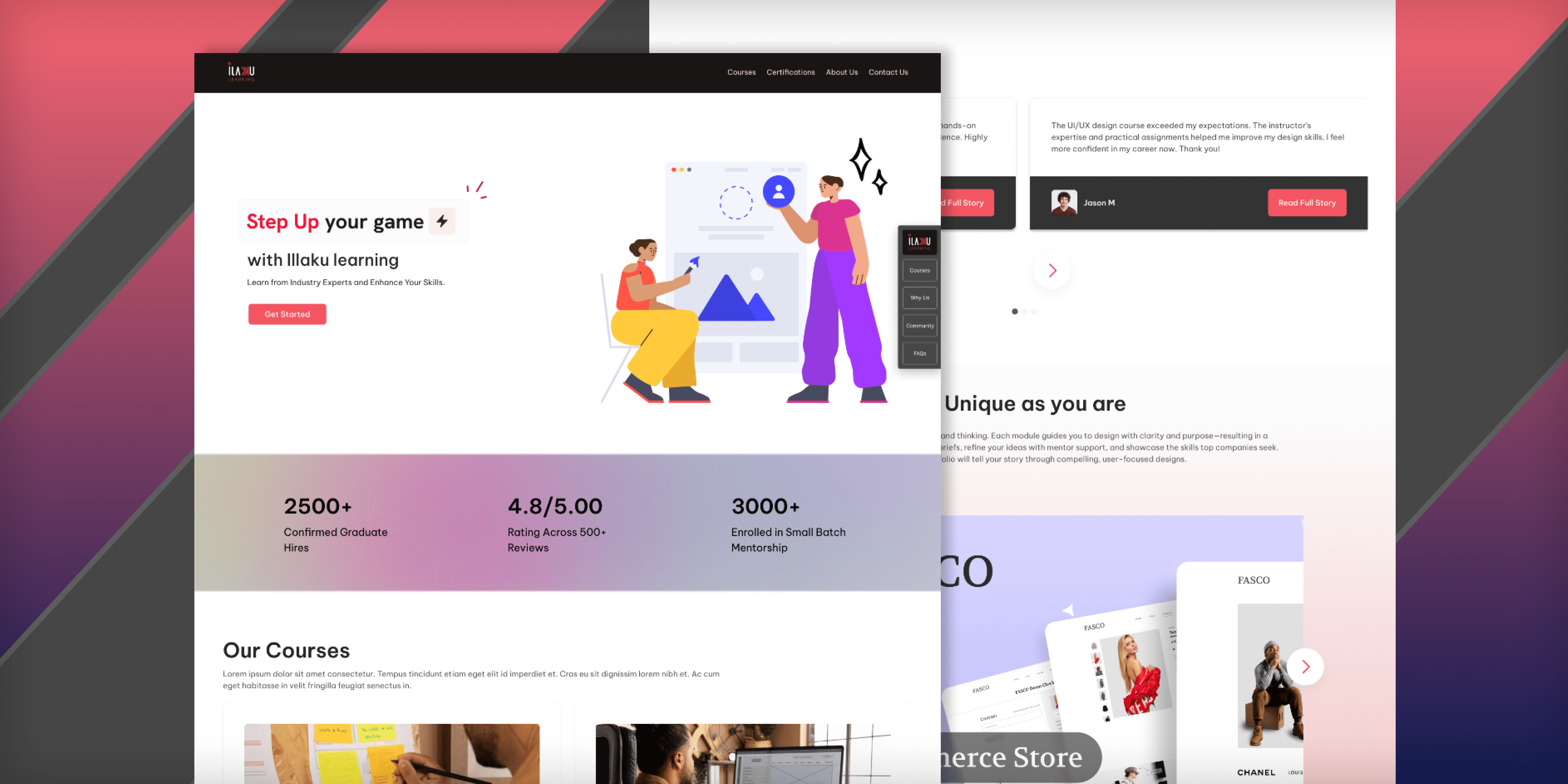
Ilakku Learning is an online learning platform offering courses in Figma and UX. While the content is valuable, usability issues, missing core features, and weak trust signals significantly reduce user confidence and conversion. This project focuses on identifying key UX problems through research and heuristic evaluation, and proposing clear, actionable design solutions to improve usability, trust, and engagement.
Problem Statement
Despite clear user interest, Ilakku Learning presents usability and information architecture issues that hinder trust and block users from completing enrollment.
Research Process
To understand why users struggled to enroll, I conducted a focused UX audit combining qualitative research and usability evaluation methods

Heuristic Evaluation
Identified interface-level issues such as poor layout, unclear navigation, and weak visual hierarchy.

User Survey & Persona Creation
Helped understand the types of users visiting the platform, their goals, expectations, and pain points.

Usability Testing
Observed real user behavior while completing key tasks, revealing confusion around schedules, instructor interaction, and course discovery.
Issues Found from Heuristic Evaluation
Before involving users, I conducted a heuristic evaluation to quickly identify usability issues and validate whether the platform met established UX principles. This helped surface major breakdowns early and informed what to test with users next.
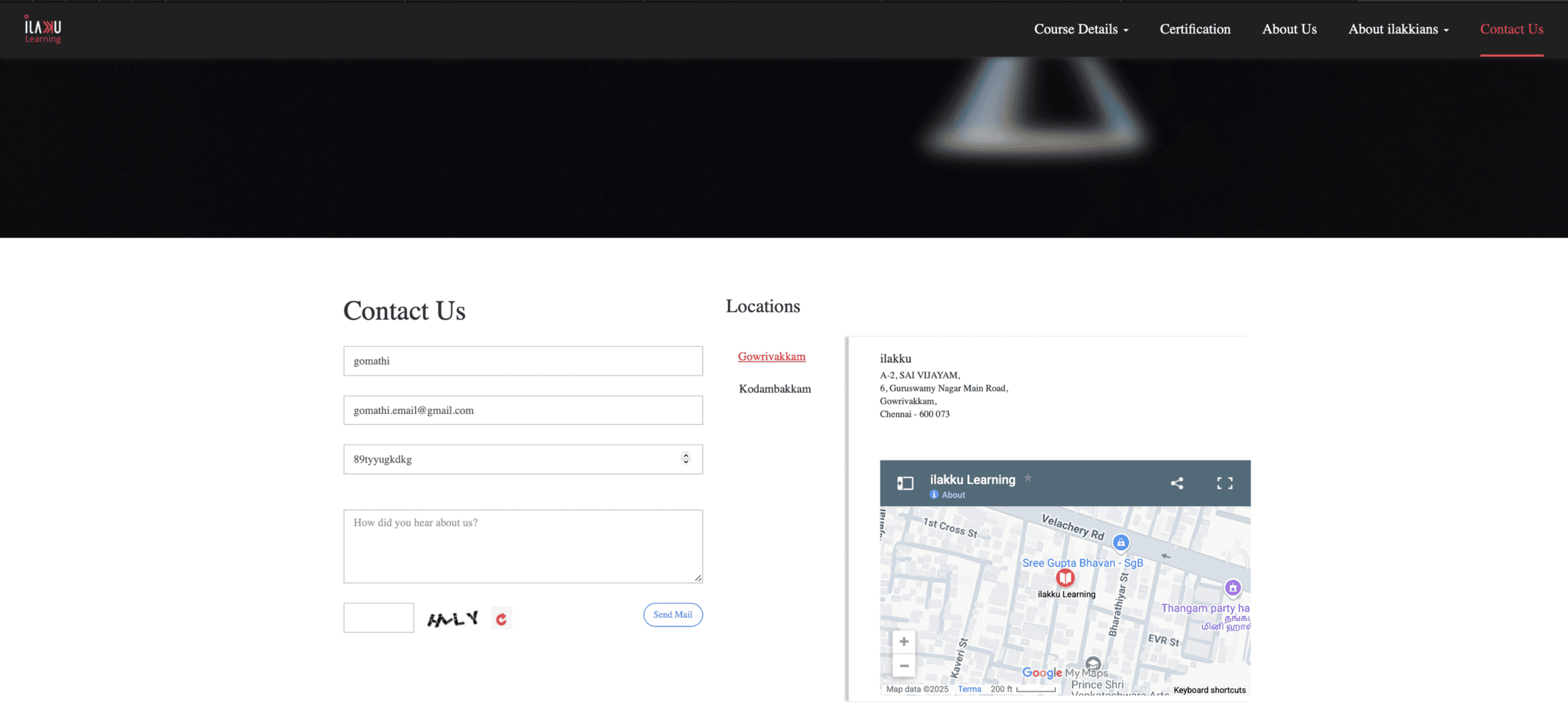
Contact Us
Visibility of System Status
No confirmation if the mail has been sent in the contact form.
Doesn't show error when alphabets is typed in phone number
Curriculum Page
Consistency and Standards
Layout Consistency: Inconsistent box sizes create a cluttered appearance.
Aesthetic and Minimalist Design
Overall Look: The page appears cluttered and could be more streamlined.
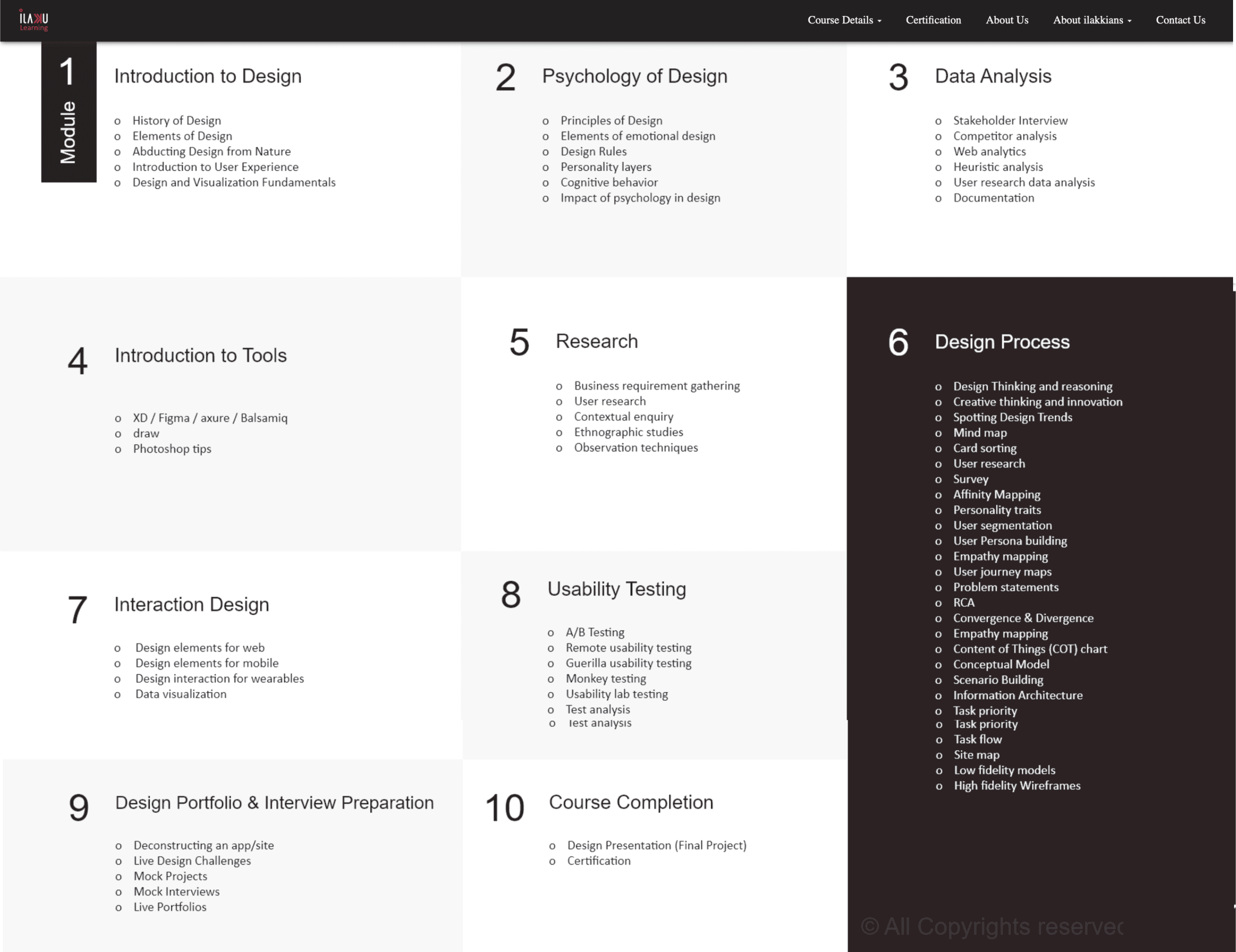
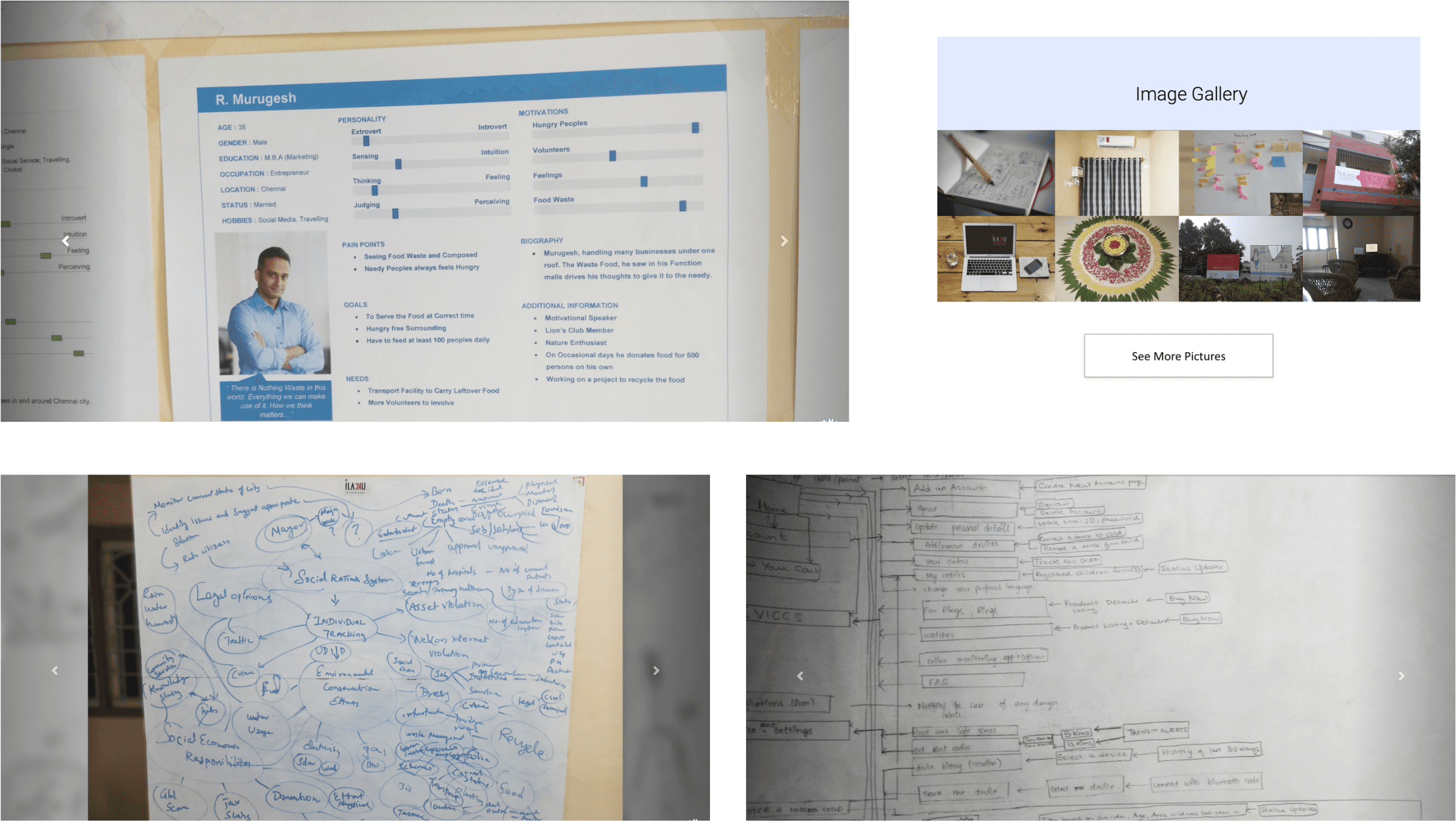
Image Gallery
Aesthetic and Minimalist Design
Cluttered Gallery: The image gallery contains irrelevant images.
Contact Us
Visibility of System Status
No confirmation if the mail has been sent in the contact form.
Doesn't show error when alphabets is typed in phone number
Curriculum Page
Consistency and Standards
Layout Consistency: Inconsistent box sizes create a cluttered appearance.
Aesthetic and Minimalist Design
Overall Look: The page appears cluttered and could be more streamlined.
Image Gallery
Aesthetic and Minimalist Design
Cluttered Gallery: The image gallery contains irrelevant images.
User Survey
Understand user expectations, trust factors, and enrollment decision drivers for an online learning platform.
Key Takeaways
80% of users consider instructor credibility essential before enrolling
70% expect clear learning outcomes and curriculum visibility
Poor visual design reduced trust for over half the participants
Users expect enrollment to be simple, visible, and guided
These findings informed the focus areas for usability testing and solution prioritization.
User Persona
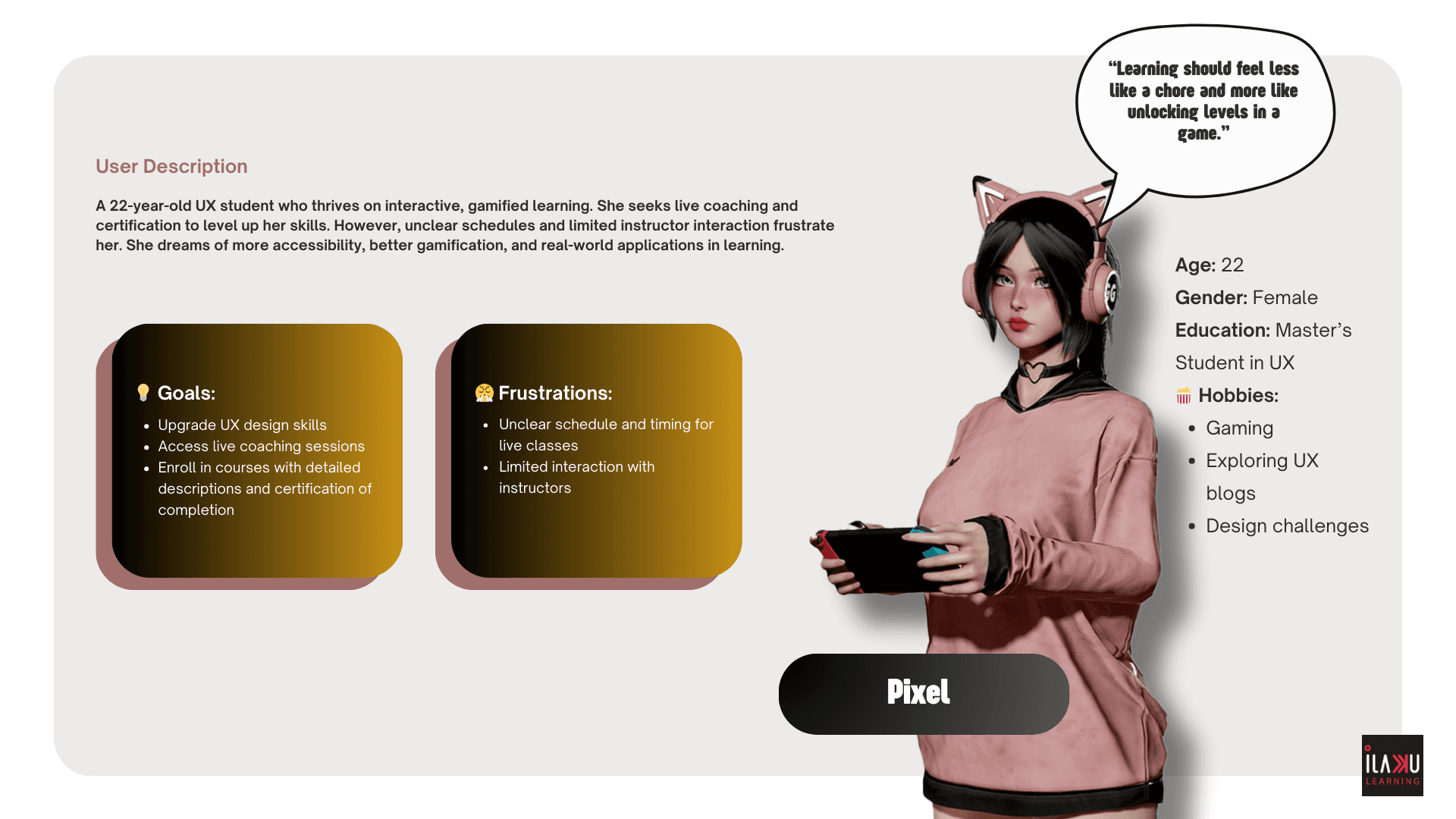
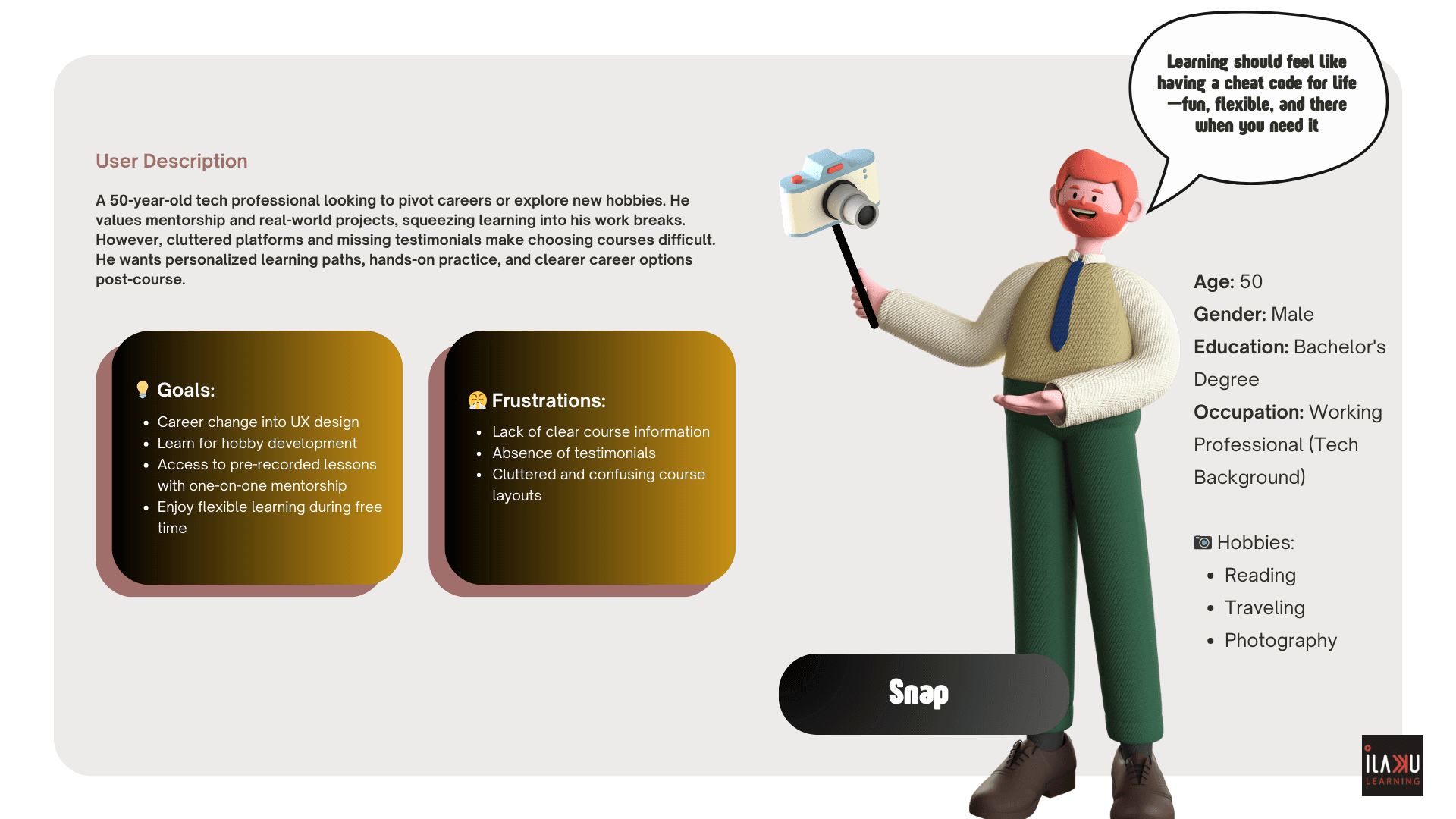
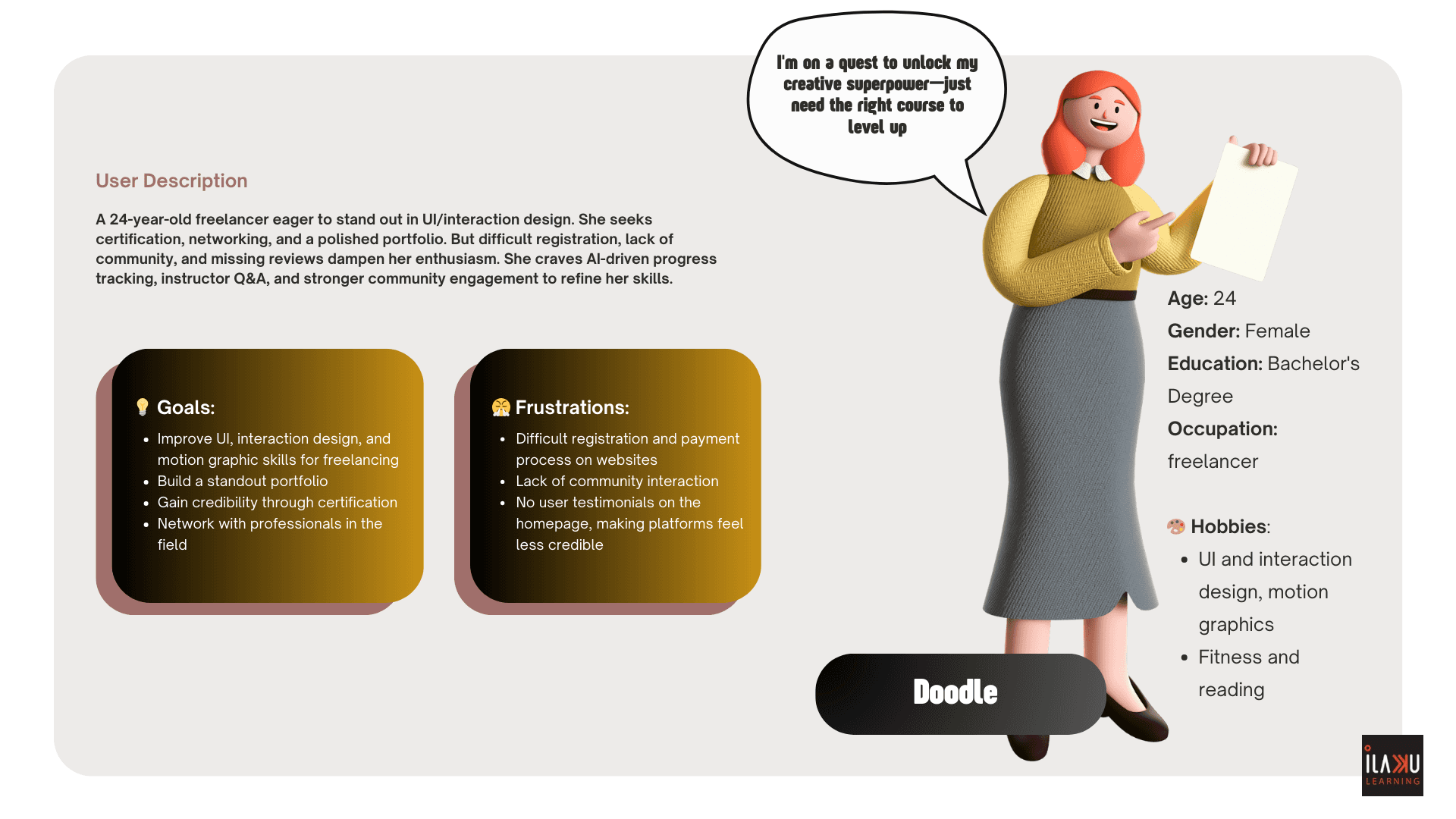
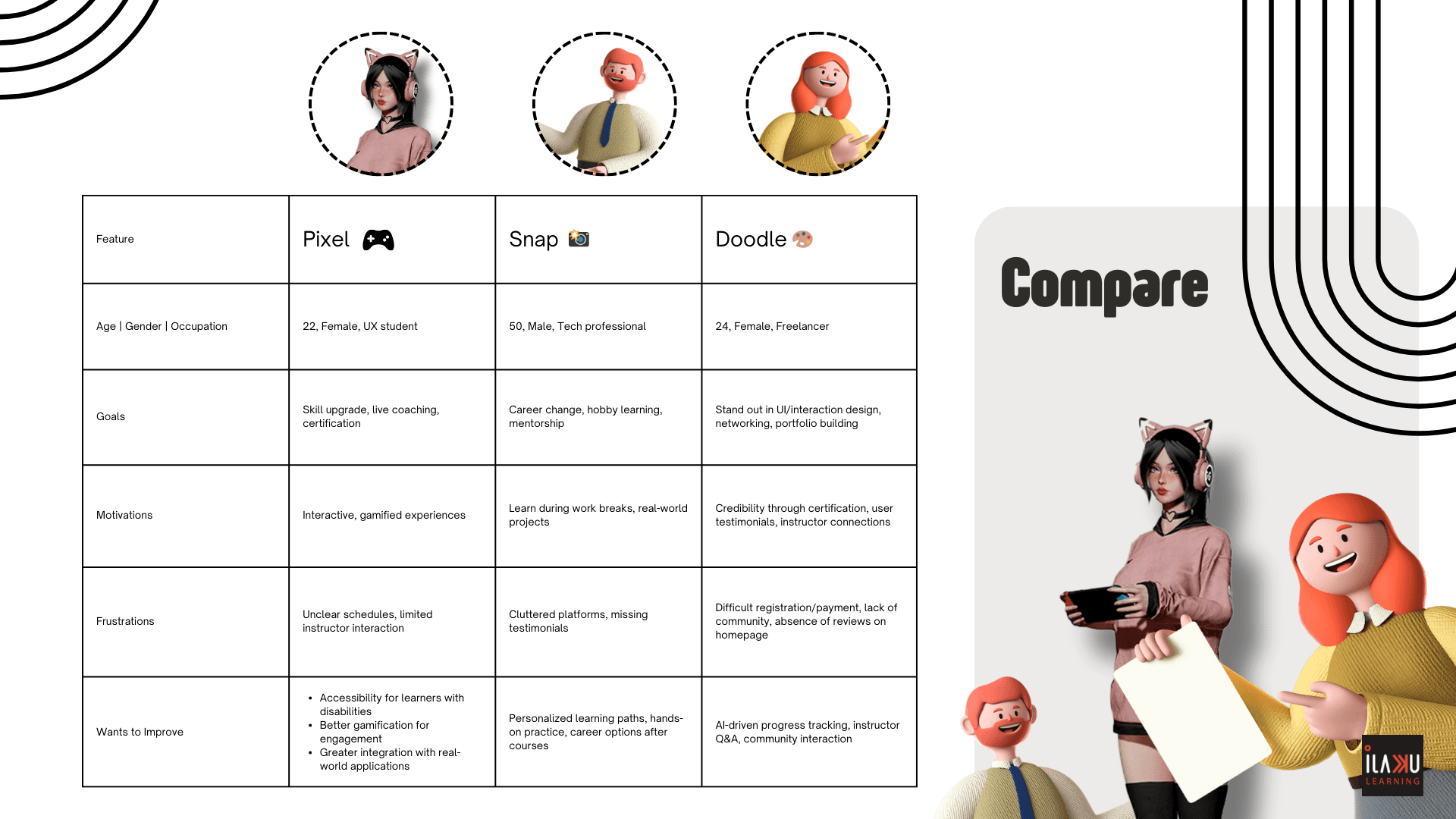
Based on survey insights, three personas were created to represent key learner types with distinct goals, behaviors, and pain points. These personas helped guide user-centered design decisions throughout the project.
Usability Testing
Evaluate how easily users could explore courses, assess credibility, and progress toward enrollment.
Key Tasks Tested
Find course details and curriculum
Understand course value (price, outcomes, certification)
Identify instructor information and begin enrollment
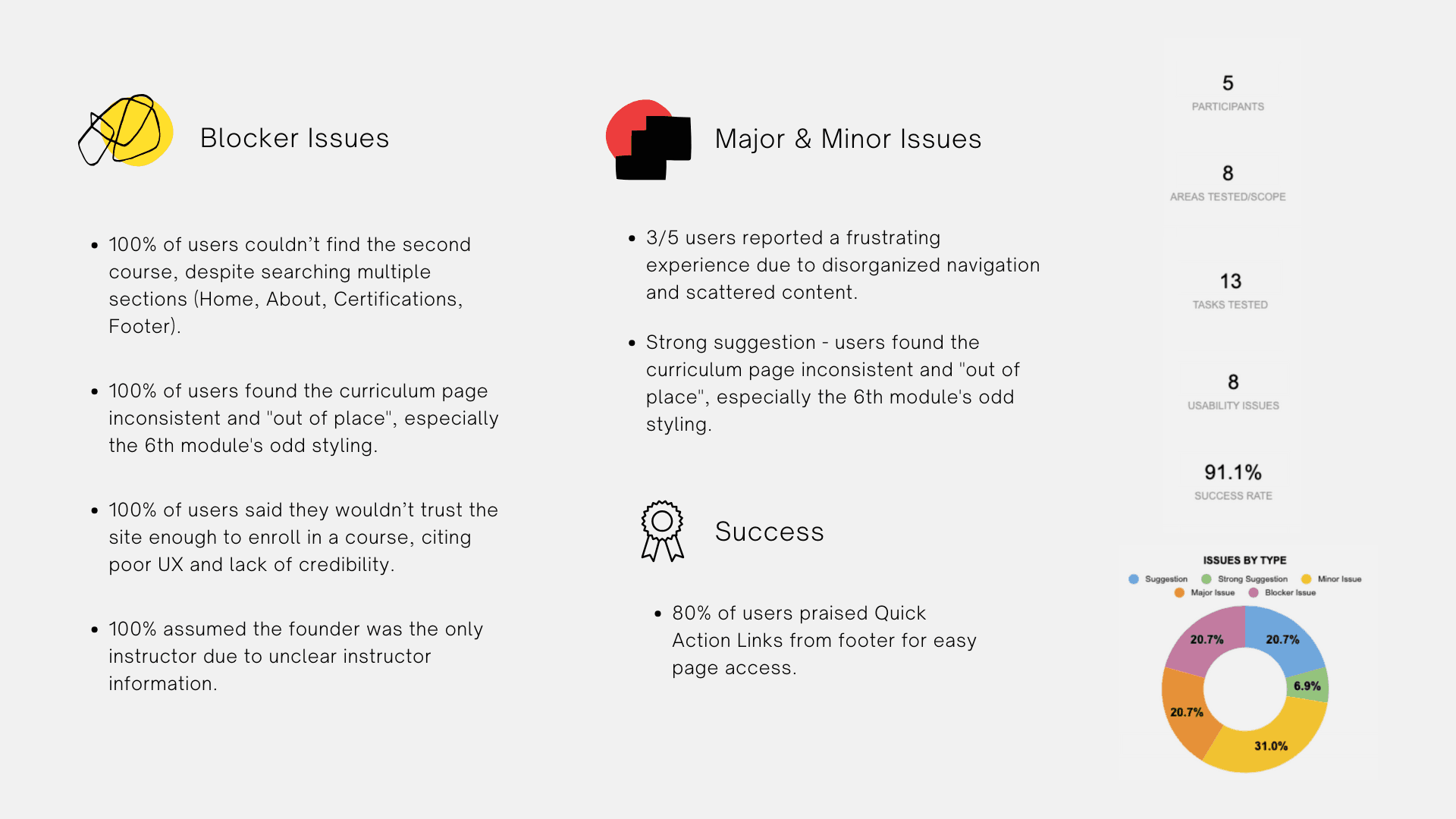
Key Insight
While users were motivated to learn, usability barriers around navigation, trust, and information clarity prevented them from confidently committing to enrollment.
Solutions
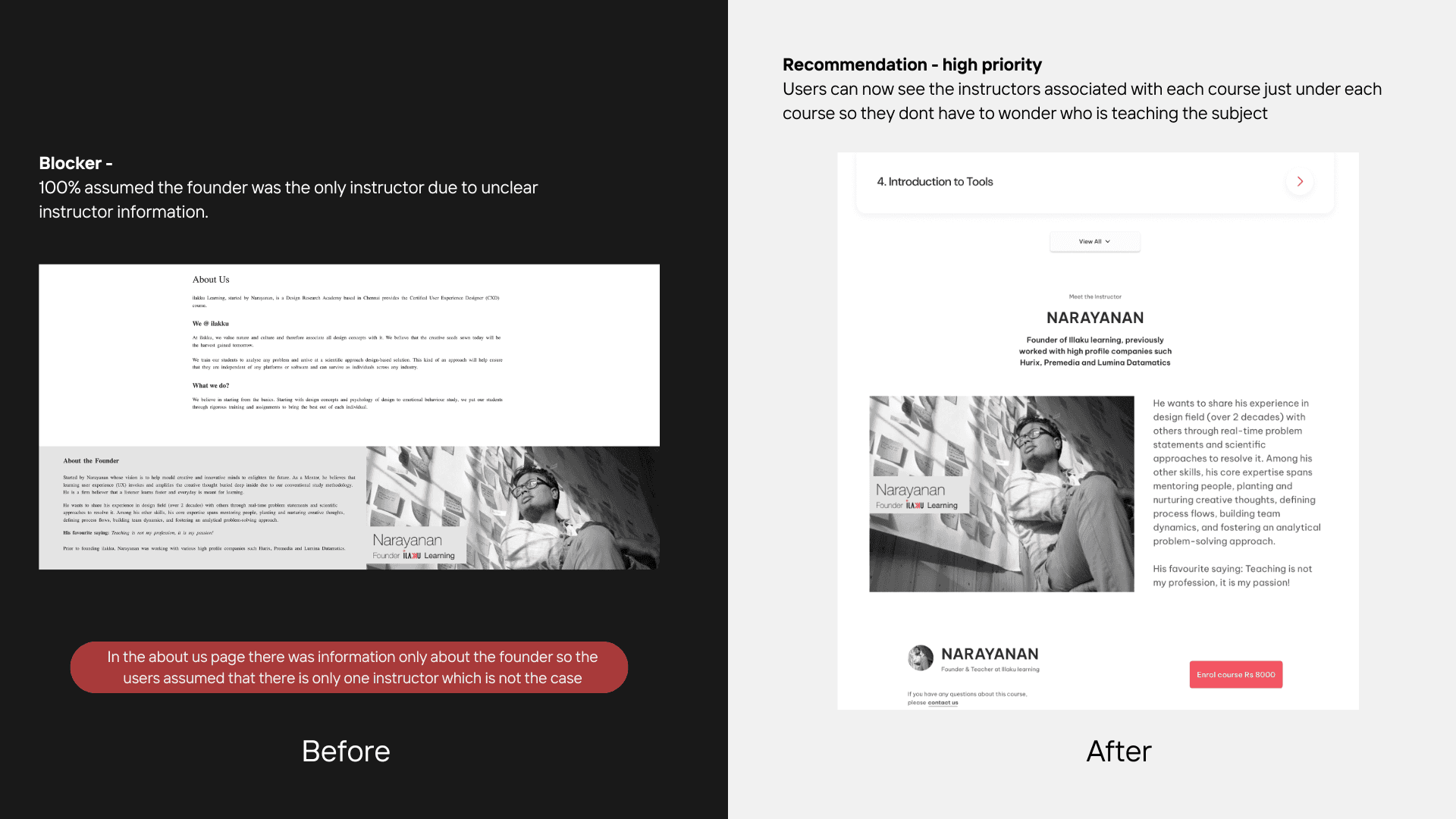
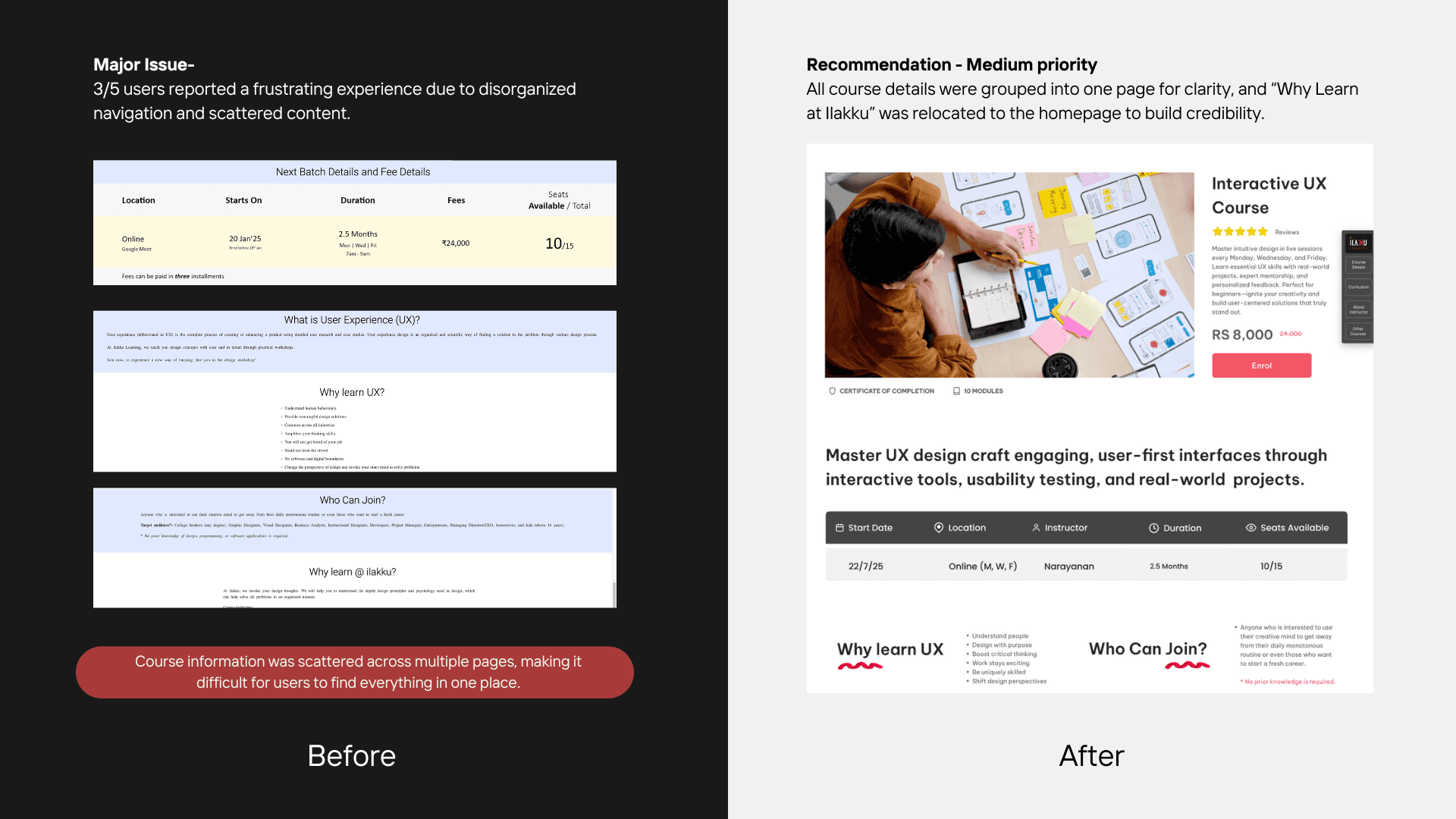
Checkout before and after images —>
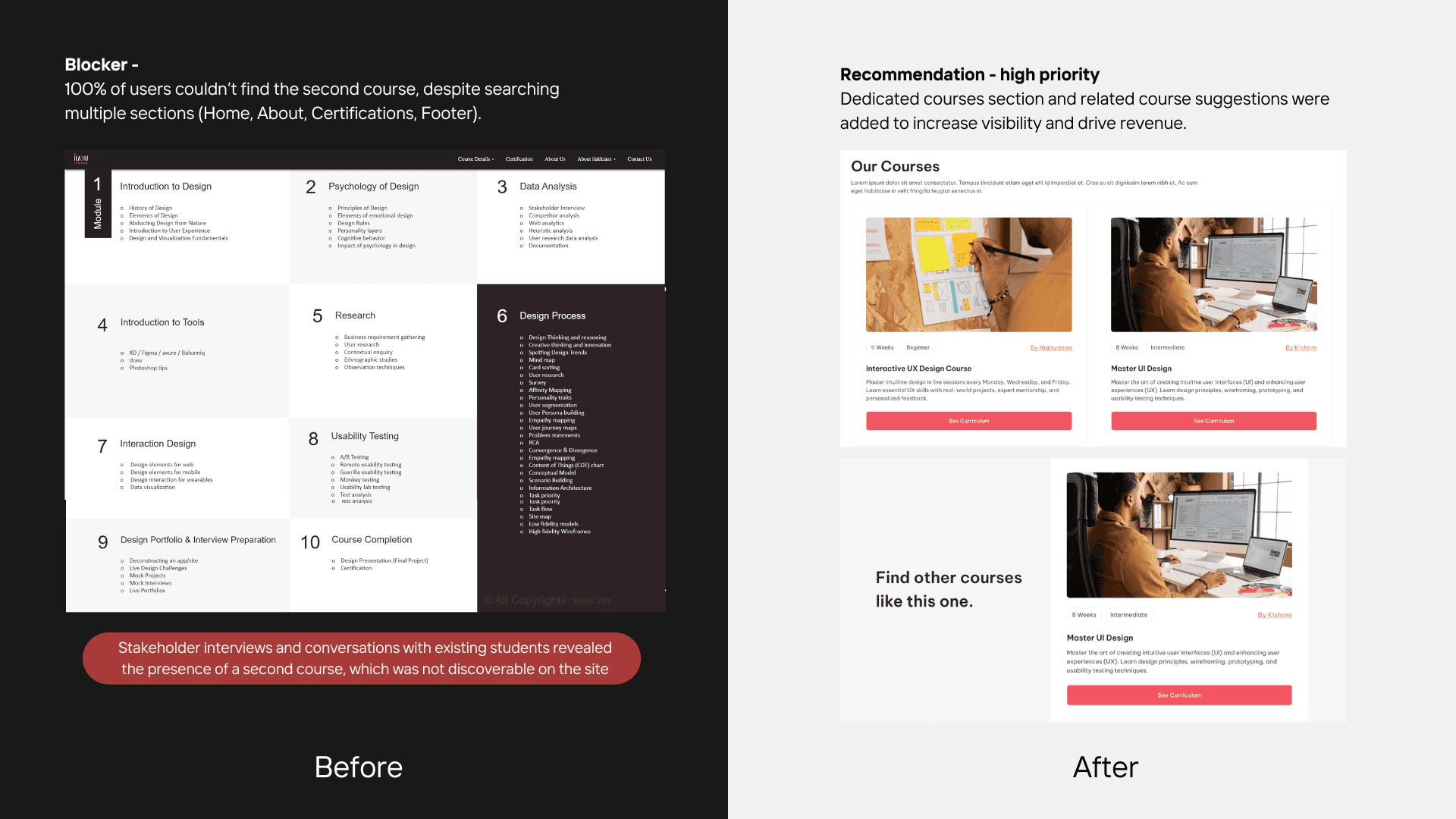
🔴 Blocker 1: Poor Course Discoverability - Dedicated Courses section and related recommendations added.
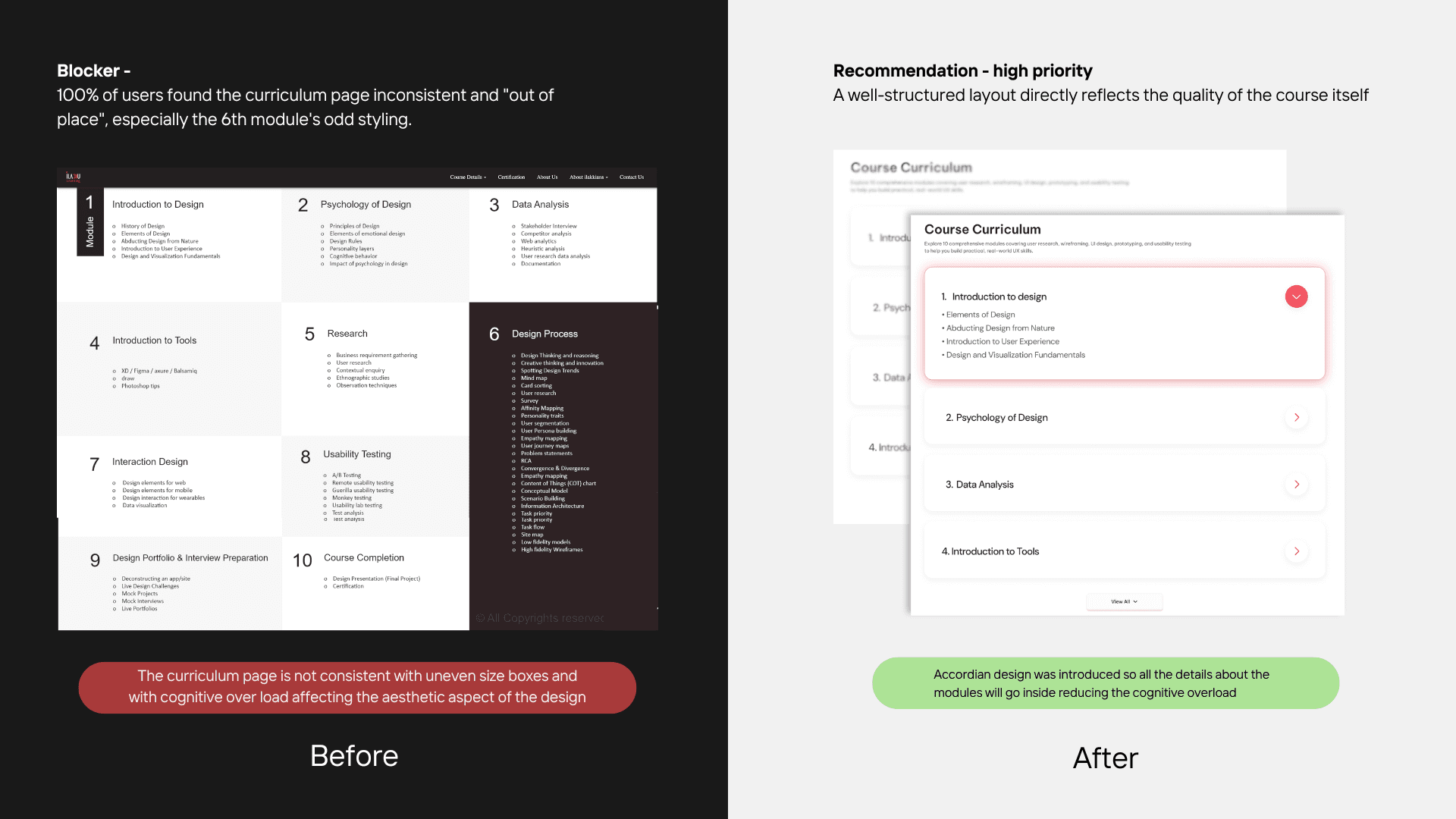
🔴 Blocker 2: Inconsistent Curriculum Layout - Accordion-based layout introduced to reduce cognitive overload.
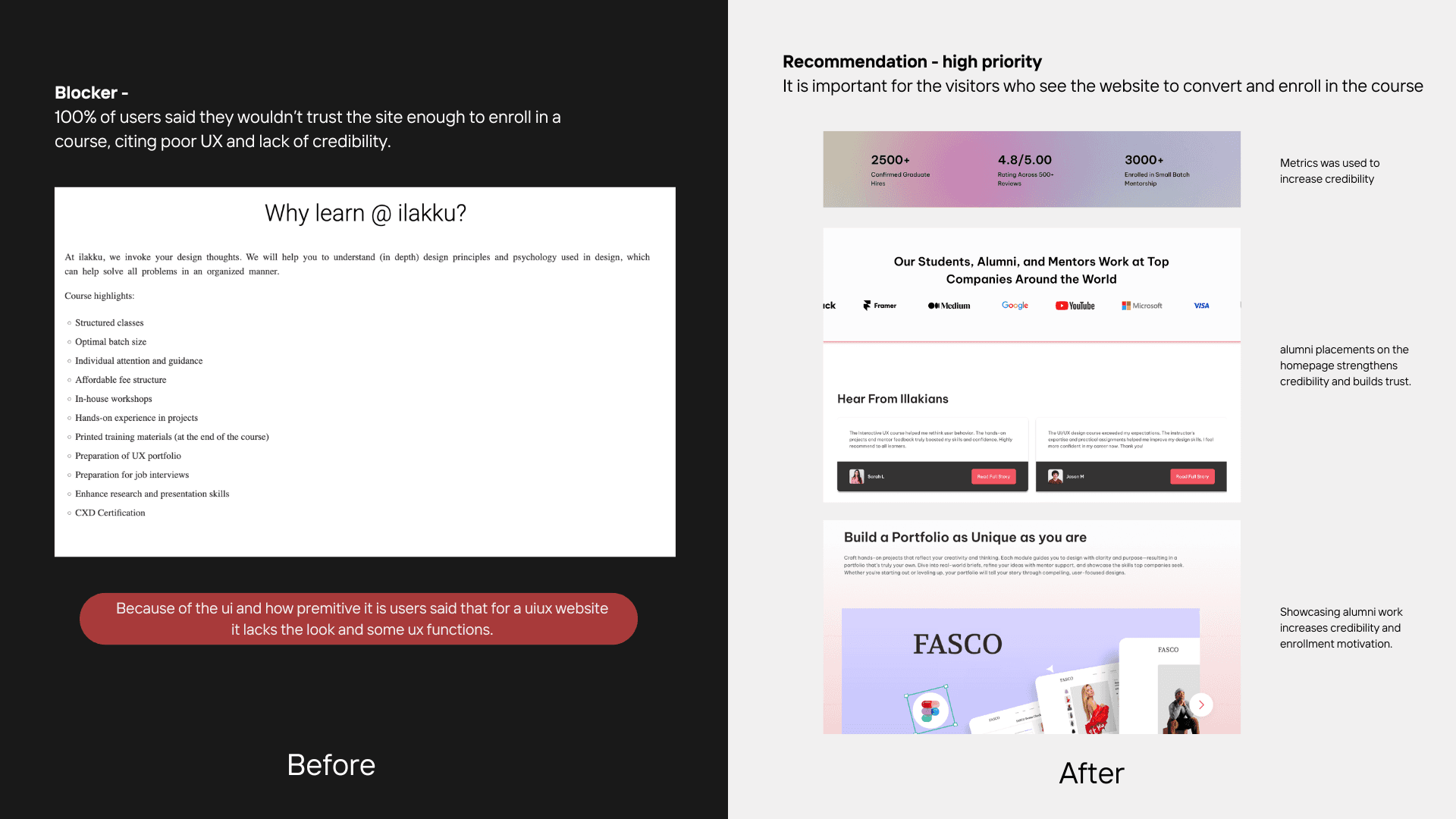
🔴 Blocker 3: Low Trust Preventing Enrollment - Testimonials, alumni outcomes, and clear hierarchy added.
🔴 Blocker 4: Unclear Instructor Information - Instructor profiles embedded directly on course pages.
🟠 Major Issue: Scattered Course Information - All course details consolidated into a single, structured page.
Interactive Prototype
Based on usability testing and heuristic evaluation findings, I redesigned key pages to address navigation issues, improve clarity, and strengthen trust. The prototype demonstrates how users can now discover courses more easily, understand course value, and confidently progress toward enrollment.
Impact
After implementing the design recommendations, the redesigned experience was tested again with the same 5 users.
Measurable Outcomes
100% of users were able to discover additional courses without confusion
100% of users successfully completed key tasks, including exploring curriculum, identifying instructors, and beginning enrollment
Users were able to initiate enrollment, enabling email capture for follow-ups, supporting business conversion and remarketing efforts
Key Insight
While users were motivated to learn, usability barriers around navigation, trust, and information clarity prevented them from confidently committing to enrollment.
Solutions
Checkout before and after images —>
🔴 Blocker 1: Poor Course Discoverability - Dedicated Courses section and related recommendations added.
🔴 Blocker 2: Inconsistent Curriculum Layout - Accordion-based layout introduced to reduce cognitive overload.
🔴 Blocker 3: Low Trust Preventing Enrollment - Testimonials, alumni outcomes, and clear hierarchy added.
🔴 Blocker 4: Unclear Instructor Information - Instructor profiles embedded directly on course pages.
🟠 Major Issue: Scattered Course Information - All course details consolidated into a single, structured page.
Interactive Prototype
Based on usability testing and heuristic evaluation findings, I redesigned key pages to address navigation issues, improve clarity, and strengthen trust. The prototype demonstrates how users can now discover courses more easily, understand course value, and confidently progress toward enrollment.
Impact
After implementing the design recommendations, the redesigned experience was tested again with the same 5 users.
Measurable Outcomes
100% of users were able to discover additional courses without confusion
100% of users successfully completed key tasks, including exploring curriculum, identifying instructors, and beginning enrollment
Users were able to initiate enrollment, enabling email capture for follow-ups, supporting business conversion and remarketing efforts
Users expressed increased confidence in the platform’s credibility
Clear course structure and instructor visibility reduced hesitation during decision-making
Improved navigation and information hierarchy lowered cognitive load and friction
Key Learnings & Takeaways
This project highlighted how poor discoverability, unclear structure, and weak trust signals can block enrollment even when user interest is high. Heuristic evaluation helped surface quick usability wins early, while usability testing revealed deeper workflow and credibility issues that analytics alone could not uncover.
By improving navigation, consolidating course information, and strengthening trust through instructor visibility and social proof, the redesigned experience reduced friction and aligned user needs with business goals, reinforcing that usability and trust are critical drivers of conversion.
Key Learnings & Takeaways
This project highlighted how poor discoverability, unclear structure, and weak trust signals can block enrollment even when user interest is high. Heuristic evaluation helped surface quick usability wins early, while usability testing revealed deeper workflow and credibility issues that analytics alone could not uncover.
By improving navigation, consolidating course information, and strengthening trust through instructor visibility and social proof, the redesigned experience reduced friction and aligned user needs with business goals, reinforcing that usability and trust are critical drivers of conversion.

Hi
Let’s build something impactful together
UX RESEARCH
USABILITY TESTING
HEURISTIC EVALUATION
SURVEY
E- learning website redesign
Tools
Figma
Industry
Ed Tech
Project Duration
Jan25 – May25
UX RESEARCH
HEURISTIC EVALUATION
USABILITY TESTING
SURVEY
Ilakku Learning – UX Audit & Redesign Case Study
Tools
Figma
Industry
Ed Tech
Project Duration
Jan 2025 – May 2025
TL;DR
Ilakku Learning is an online learning platform offering courses in Figma and UX. While the content is valuable, usability issues, missing core features, and weak trust signals significantly reduce user confidence and conversion. This project focuses on identifying key UX problems through research and heuristic evaluation, and proposing clear, actionable design solutions to improve usability, trust, and engagement.
Problem Statement
Despite clear user interest, Ilakku Learning presents usability and information architecture issues that hinder trust and block users from completing enrollment.
Research Process
To understand why users struggled to enroll, I conducted a focused UX audit combining qualitative research and usability evaluation methods
Heuristic Evaluation
Identified interface-level issues such as poor layout, unclear navigation, and weak visual hierarchy.
User Survey & Persona Creation
Helped understand the types of users visiting the platform, their goals, expectations, and pain points.
Usability Testing
Observed real user behavior while completing key tasks, revealing confusion around schedules, instructor interaction, and course discovery.
Issues Found from Heuristic Evaluation
Before involving users, I conducted a heuristic evaluation to quickly identify usability issues and validate whether the platform met established UX principles. This helped surface major breakdowns early and informed what to test with users next.
Contact Us
Visibility of System Status
No confirmation if the mail has been sent in the contact form.
Doesn't show error when alphabets is typed in phone number
Curriculum Page
Consistency and Standards
Layout Consistency: Inconsistent box sizes create a cluttered appearance.
Aesthetic and Minimalist Design
Overall Look: The page appears cluttered and could be more streamlined.
Image Gallery
Aesthetic and Minimalist Design
Cluttered Gallery: The image gallery contains irrelevant images.
Contact Us
Visibility of System Status
No confirmation if the mail has been sent in the contact form.
Doesn't show error when alphabets is typed in phone number
Curriculum Page
Consistency and Standards
Layout Consistency: Inconsistent box sizes create a cluttered appearance.
Aesthetic and Minimalist Design
Overall Look: The page appears cluttered and could be more streamlined.
Image Gallery
Aesthetic and Minimalist Design
Cluttered Gallery: The image gallery contains irrelevant images.
User Survey
Understand user expectations, trust factors, and enrollment decision drivers for an online learning platform.
Key Takeaways
80% of users consider instructor credibility essential before enrolling
70% expect clear learning outcomes and curriculum visibility
Poor visual design reduced trust for over half the participants
Users expect enrollment to be simple, visible, and guided
These findings informed the focus areas for usability testing and solution prioritization.
User Persona
Based on survey insights, three personas were created to represent key learner types with distinct goals, behaviors, and pain points. These personas helped guide user-centered design decisions throughout the project.
Usability Testing
Evaluate how easily users could explore courses, assess credibility, and progress toward enrollment.
Key Tasks Tested
Find course details and curriculum
Understand course value (price, outcomes, certification)
Identify instructor information and begin enrollment
Key Insight
While users were motivated to learn, usability barriers around navigation, trust, and information clarity prevented them from confidently committing to enrollment.
Solutions
Checkout before and after images —>
🔴 Blocker 1: Poor Course Discoverability - Dedicated Courses section and related recommendations added.
🔴 Blocker 2: Inconsistent Curriculum Layout - Accordion-based layout introduced to reduce cognitive overload.
🔴 Blocker 3: Low Trust Preventing Enrollment - Testimonials, alumni outcomes, and clear hierarchy added.
🔴 Blocker 4: Unclear Instructor Information - Instructor profiles embedded directly on course pages.
🟠 Major Issue: Scattered Course Information - All course details consolidated into a single, structured page.
Interactive Prototype
Based on usability testing and heuristic evaluation findings, I redesigned key pages to address navigation issues, improve clarity, and strengthen trust. The prototype demonstrates how users can now discover courses more easily, understand course value, and confidently progress toward enrollment.
Impact
After implementing the design recommendations, the redesigned experience was tested again with the same 5 users.
Measurable Outcomes
100% of users were able to discover additional courses without confusion
100% of users successfully completed key tasks, including exploring curriculum, identifying instructors, and beginning enrollment
Users were able to initiate enrollment, enabling email capture for follow-ups, supporting business conversion and remarketing efforts
Key Insight
While users were motivated to learn, usability barriers around navigation, trust, and information clarity prevented them from confidently committing to enrollment.
Solutions
Checkout before and after images —>
🔴 Blocker 1: Poor Course Discoverability - Dedicated Courses section and related recommendations added.
🔴 Blocker 2: Inconsistent Curriculum Layout - Accordion-based layout introduced to reduce cognitive overload.
🔴 Blocker 3: Low Trust Preventing Enrollment - Testimonials, alumni outcomes, and clear hierarchy added.
🔴 Blocker 4: Unclear Instructor Information - Instructor profiles embedded directly on course pages.
🟠 Major Issue: Scattered Course Information - All course details consolidated into a single, structured page.
Interactive Prototype
Based on usability testing and heuristic evaluation findings, I redesigned key pages to address navigation issues, improve clarity, and strengthen trust. The prototype demonstrates how users can now discover courses more easily, understand course value, and confidently progress toward enrollment.
Impact
After implementing the design recommendations, the redesigned experience was tested again with the same 5 users.
Measurable Outcomes
100% of users were able to discover additional courses without confusion
100% of users successfully completed key tasks, including exploring curriculum, identifying instructors, and beginning enrollment
Users were able to initiate enrollment, enabling email capture for follow-ups, supporting business conversion and remarketing efforts
Users expressed increased confidence in the platform’s credibility
Clear course structure and instructor visibility reduced hesitation during decision-making
Improved navigation and information hierarchy lowered cognitive load and friction
Key Learnings & Takeaways
This project highlighted how poor discoverability, unclear structure, and weak trust signals can block enrollment even when user interest is high. Heuristic evaluation helped surface quick usability wins early, while usability testing revealed deeper workflow and credibility issues that analytics alone could not uncover.
By improving navigation, consolidating course information, and strengthening trust through instructor visibility and social proof, the redesigned experience reduced friction and aligned user needs with business goals, reinforcing that usability and trust are critical drivers of conversion.
Key Learnings & Takeaways
This project highlighted how poor discoverability, unclear structure, and weak trust signals can block enrollment even when user interest is high. Heuristic evaluation helped surface quick usability wins early, while usability testing revealed deeper workflow and credibility issues that analytics alone could not uncover.
By improving navigation, consolidating course information, and strengthening trust through instructor visibility and social proof, the redesigned experience reduced friction and aligned user needs with business goals, reinforcing that usability and trust are critical drivers of conversion.
Hi
Let’s build something impactful together
UX RESEARCH
USABILITY TESTING
HEURISTIC EVALUATION
SURVEY
E- learning website redesign
Tools
Figma
Industry
Ed Tech
Project Duration
Jan25 – May25
UX RESEARCH
HEURISTIC EVALUATION
USABILITY TESTING
SURVEY
Ilakku Learning – UX Audit & Redesign Case Study
Tools
Figma
Industry
Ed Tech
Project Duration
Jan 2025 – May 2025
TL;DR
Ilakku Learning is an online learning platform offering courses in Figma and UX. While the content is valuable, usability issues, missing core features, and weak trust signals significantly reduce user confidence and conversion. This project focuses on identifying key UX problems through research and heuristic evaluation, and proposing clear, actionable design solutions to improve usability, trust, and engagement.
Problem Statement
Despite clear user interest, Ilakku Learning presents usability and information architecture issues that hinder trust and block users from completing enrollment.
Research Process
To understand why users struggled to enroll, I conducted a focused UX audit combining qualitative research and usability evaluation methods
Heuristic Evaluation
Identified interface-level issues such as poor layout, unclear navigation, and weak visual hierarchy.
User Survey & Persona Creation
Helped understand the types of users visiting the platform, their goals, expectations, and pain points.
Usability Testing
Observed real user behavior while completing key tasks, revealing confusion around schedules, instructor interaction, and course discovery.
Issues Found from Heuristic Evaluation
Before involving users, I conducted a heuristic evaluation to quickly identify usability issues and validate whether the platform met established UX principles. This helped surface major breakdowns early and informed what to test with users next.
Contact Us
Visibility of System Status
No confirmation if the mail has been sent in the contact form.
Doesn't show error when alphabets is typed in phone number
Curriculum Page
Consistency and Standards
Layout Consistency: Inconsistent box sizes create a cluttered appearance.
Aesthetic and Minimalist Design
Overall Look: The page appears cluttered and could be more streamlined.
Image Gallery
Aesthetic and Minimalist Design
Cluttered Gallery: The image gallery contains irrelevant images.
Contact Us
Visibility of System Status
No confirmation if the mail has been sent in the contact form.
Doesn't show error when alphabets is typed in phone number
Curriculum Page
Consistency and Standards
Layout Consistency: Inconsistent box sizes create a cluttered appearance.
Aesthetic and Minimalist Design
Overall Look: The page appears cluttered and could be more streamlined.
Image Gallery
Aesthetic and Minimalist Design
Cluttered Gallery: The image gallery contains irrelevant images.
User Survey
Understand user expectations, trust factors, and enrollment decision drivers for an online learning platform.
Key Takeaways
80% of users consider instructor credibility essential before enrolling
70% expect clear learning outcomes and curriculum visibility
Poor visual design reduced trust for over half the participants
Users expect enrollment to be simple, visible, and guided
These findings informed the focus areas for usability testing and solution prioritization.
User Persona
Based on survey insights, three personas were created to represent key learner types with distinct goals, behaviors, and pain points. These personas helped guide user-centered design decisions throughout the project.
Usability Testing
Evaluate how easily users could explore courses, assess credibility, and progress toward enrollment.
Key Tasks Tested
Find course details and curriculum
Understand course value (price, outcomes, certification)
Identify instructor information and begin enrollment
Key Insight
While users were motivated to learn, usability barriers around navigation, trust, and information clarity prevented them from confidently committing to enrollment.
Solutions
Checkout before and after images —>
🔴 Blocker 1: Poor Course Discoverability - Dedicated Courses section and related recommendations added.
🔴 Blocker 2: Inconsistent Curriculum Layout - Accordion-based layout introduced to reduce cognitive overload.
🔴 Blocker 3: Low Trust Preventing Enrollment - Testimonials, alumni outcomes, and clear hierarchy added.
🔴 Blocker 4: Unclear Instructor Information - Instructor profiles embedded directly on course pages.
🟠 Major Issue: Scattered Course Information - All course details consolidated into a single, structured page.
Interactive Prototype
Based on usability testing and heuristic evaluation findings, I redesigned key pages to address navigation issues, improve clarity, and strengthen trust. The prototype demonstrates how users can now discover courses more easily, understand course value, and confidently progress toward enrollment.
Impact
After implementing the design recommendations, the redesigned experience was tested again with the same 5 users.
Measurable Outcomes
100% of users were able to discover additional courses without confusion
100% of users successfully completed key tasks, including exploring curriculum, identifying instructors, and beginning enrollment
Users were able to initiate enrollment, enabling email capture for follow-ups, supporting business conversion and remarketing efforts
Key Insight
While users were motivated to learn, usability barriers around navigation, trust, and information clarity prevented them from confidently committing to enrollment.
Solutions
Checkout before and after images —>
🔴 Blocker 1: Poor Course Discoverability - Dedicated Courses section and related recommendations added.
🔴 Blocker 2: Inconsistent Curriculum Layout - Accordion-based layout introduced to reduce cognitive overload.
🔴 Blocker 3: Low Trust Preventing Enrollment - Testimonials, alumni outcomes, and clear hierarchy added.
🔴 Blocker 4: Unclear Instructor Information - Instructor profiles embedded directly on course pages.
🟠 Major Issue: Scattered Course Information - All course details consolidated into a single, structured page.
Interactive Prototype
Based on usability testing and heuristic evaluation findings, I redesigned key pages to address navigation issues, improve clarity, and strengthen trust. The prototype demonstrates how users can now discover courses more easily, understand course value, and confidently progress toward enrollment.
Impact
After implementing the design recommendations, the redesigned experience was tested again with the same 5 users.
Measurable Outcomes
100% of users were able to discover additional courses without confusion
100% of users successfully completed key tasks, including exploring curriculum, identifying instructors, and beginning enrollment
Users were able to initiate enrollment, enabling email capture for follow-ups, supporting business conversion and remarketing efforts
Users expressed increased confidence in the platform’s credibility
Clear course structure and instructor visibility reduced hesitation during decision-making
Improved navigation and information hierarchy lowered cognitive load and friction
Key Learnings & Takeaways
This project highlighted how poor discoverability, unclear structure, and weak trust signals can block enrollment even when user interest is high. Heuristic evaluation helped surface quick usability wins early, while usability testing revealed deeper workflow and credibility issues that analytics alone could not uncover.
By improving navigation, consolidating course information, and strengthening trust through instructor visibility and social proof, the redesigned experience reduced friction and aligned user needs with business goals, reinforcing that usability and trust are critical drivers of conversion.
Key Learnings & Takeaways
This project highlighted how poor discoverability, unclear structure, and weak trust signals can block enrollment even when user interest is high. Heuristic evaluation helped surface quick usability wins early, while usability testing revealed deeper workflow and credibility issues that analytics alone could not uncover.
By improving navigation, consolidating course information, and strengthening trust through instructor visibility and social proof, the redesigned experience reduced friction and aligned user needs with business goals, reinforcing that usability and trust are critical drivers of conversion.
Hi